Fluorine is more electronegative than chlorine, yet fluoromethane
1CH3F; m = 1.86 D2 has a smaller dipole moment
than chloromethane 1CH3Cl; m = 1.90 D2. Explain.
검증된 단계별 안내
1
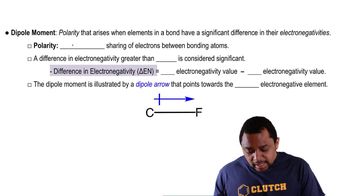
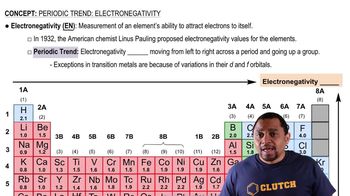
Step 1: Understand the concept of electronegativity. Electronegativity is a measure of the tendency of an atom to attract a bonding pair of electrons. The higher the electronegativity, the greater the atom's strength to attract a pair of electrons.
Step 2: Understand the concept of dipole moment. The dipole moment of a molecule is the measure of its polarity. It depends on both the magnitude of the charge and the distance between the charges. It is calculated as the product of the charge and the distance between the charges.
Step 3: Consider the structure of fluoromethane (CH3F) and chloromethane (CH3Cl). Both molecules are tetrahedral in shape, with the hydrogen atoms and the halogen atom (F or Cl) surrounding the central carbon atom.
Step 4: Although fluorine is more electronegative than chlorine, the carbon-fluorine bond in fluoromethane is shorter than the carbon-chlorine bond in chloromethane due to the smaller size of the fluorine atom. This means that the separation of charges in fluoromethane is less than in chloromethane.
Step 5: Therefore, despite fluorine's higher electronegativity, the dipole moment of fluoromethane is smaller than that of chloromethane because the dipole moment depends on both the charge difference and the distance between the charges. In this case, the larger distance in chloromethane outweighs the larger charge difference in fluoromethane, resulting in a larger overall dipole moment for chloromethane.
비슷한 문제에 대한 검증된 영상 답변:
이 영상 해법은 위 문제에 도움이 된다고 튜터들이 추천한 것입니다.
영상 길이:
3m
영상 재생:
0 댓글
주요 개념
질문에 올바르게 답하기 위해 반드시 이해해야 하는 핵심 개념들은 다음과 같습니다.
Electronegativity
Electronegativity is a measure of an atom's ability to attract and hold onto electrons in a chemical bond. Fluorine is the most electronegative element, meaning it has a strong tendency to attract electrons compared to chlorine. This property influences the polarity of bonds formed with other atoms, affecting molecular dipole moments.
The dipole moment is a vector quantity that measures the separation of positive and negative charges in a molecule. It is influenced by both the magnitude of the charge and the distance between the charges. A higher dipole moment indicates a greater polarity, which can be affected by molecular geometry and the arrangement of atoms within the molecule.
Molecular geometry refers to the three-dimensional arrangement of atoms in a molecule. The shape of a molecule can significantly influence its dipole moment, as the spatial distribution of polar bonds determines how the individual dipoles combine. In the case of fluoromethane and chloromethane, differences in geometry can lead to variations in their overall dipole moments despite the electronegativity differences.


 검증된 단계별 안내
 02:10
02:10