Ch.12 - Solids and Solid-State Materials
McMurry - Chemistry 8th Edition
McMurry8th EditionChemistryISBN: 9781292336145당신이 사용하는 게 아니라요?교과서 변경
12장, 문제 20

Titanium oxide crystallizes in the following cubic unit cell: Diagram of a face-centered cubic unit cell showing Zn and F atoms in a crystal structure.
(b) What is the formula of titanium oxide?

검증된 단계별 안내
1
Identify the positions of the titanium (Ti) and oxygen (O) atoms in the unit cell. In the given diagram, the blue spheres represent Zn atoms and the red spheres represent F atoms. For this problem, assume Zn represents Ti and F represents O.
Determine the number of Ti atoms in the unit cell. Ti atoms are located at the corners and the center of each face of the cubic unit cell. Each corner atom is shared by 8 unit cells, and each face-centered atom is shared by 2 unit cells.
Calculate the total contribution of Ti atoms in the unit cell. There are 8 corner atoms, each contributing 1/8 of an atom, and 6 face-centered atoms, each contributing 1/2 of an atom.
Determine the number of O atoms in the unit cell. O atoms are located entirely within the unit cell, so each O atom counts fully.
Calculate the total number of O atoms in the unit cell. There are 4 O atoms inside the unit cell. Combine the contributions of Ti and O atoms to determine the empirical formula of titanium oxide.

비슷한 문제에 대한 검증된 영상 답변:

이 영상 해법은 위 문제에 도움이 된다고 튜터들이 추천한 것입니다.
영상 길이:
1m
도움이 되었나요?

주요 개념

질문에 올바르게 답하기 위해 반드시 이해해야 하는 핵심 개념들은 다음과 같습니다.

Unit Cell Structure

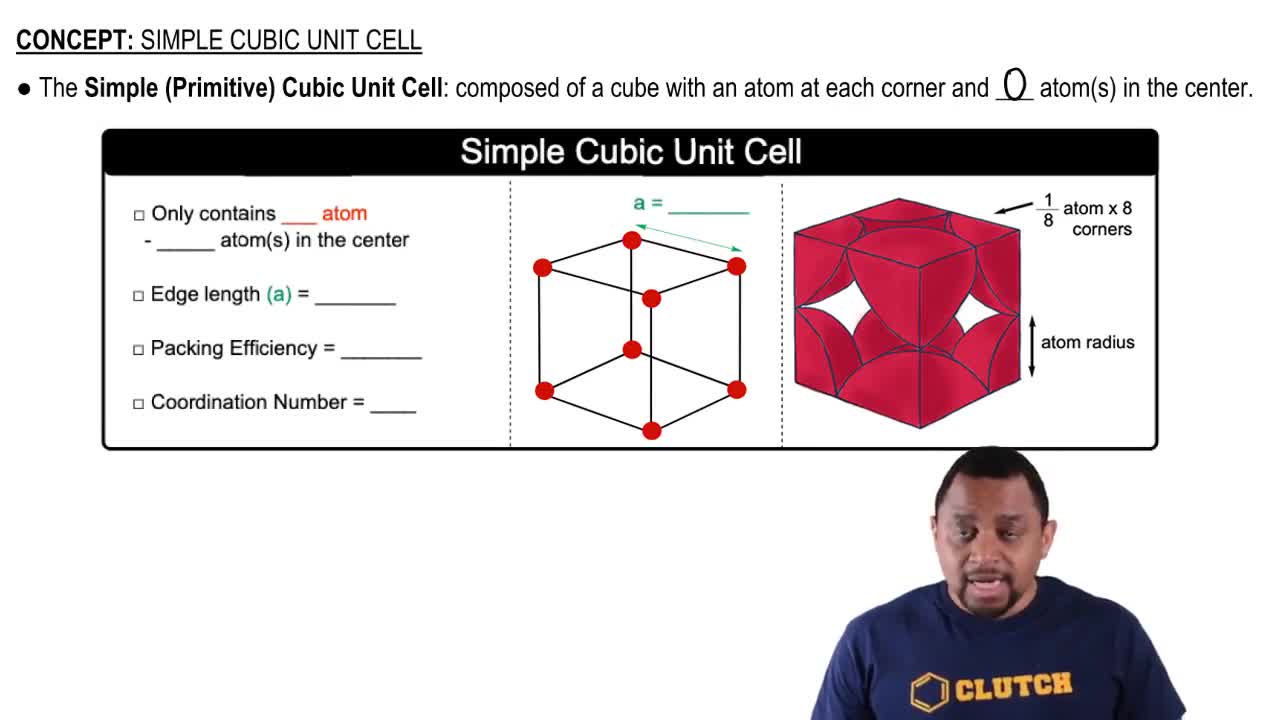
A unit cell is the smallest repeating unit in a crystal lattice that reflects the overall symmetry and structure of the entire crystal. In the case of titanium oxide, understanding the arrangement of atoms within the cubic unit cell is crucial for determining the stoichiometry and formula of the compound. The face-centered cubic structure indicates how atoms are positioned at the corners and the centers of the faces of the cube.
추천 영상:
가이드 코스
01:27
Simple Cubic Unit Cell

Stoichiometry

Stoichiometry involves the calculation of reactants and products in chemical reactions, based on the conservation of mass. For titanium oxide, knowing the ratio of titanium to oxygen atoms in the unit cell allows us to derive its chemical formula. This concept is essential for understanding how different elements combine in fixed ratios to form compounds.
추천 영상:
가이드 코스
01:16
Stoichiometry Concept

Ionic Compounds

Ionic compounds are formed through the electrostatic attraction between positively and negatively charged ions. In the case of titanium oxide, titanium typically forms a cation (Ti^4+) while oxygen forms an anion (O^2-). The balance of these charges is critical in determining the empirical formula, which reflects the simplest whole-number ratio of the constituent ions.
추천 영상:
가이드 코스
02:11
Ionic Compounds Naming