
Ch.13 - Solutions & Their Properties
McMurry - Chemistry 8th Edition
McMurry8th EditionChemistryISBN: 9781292336145당신이 사용하는 게 아니라요?교과서 변경
13장, 문제 148

Addition of 50.00 mL of 2.238 m H2SO4 1solution density = 1.1243 g>mL2 to 50.00 mL of 2.238 M BaCl2 gives a white precipitate. (b) If you filter the mixture and add more H2SO4 solution to the filtrate, would you obtain more precipitate? Explain.

검증된 단계별 안내
1
Identify the chemical reaction: The reaction between H2SO4 and BaCl2 forms BaSO4 as a precipitate and HCl as a byproduct.
Write the balanced chemical equation: \( \text{BaCl}_2 (aq) + \text{H}_2\text{SO}_4 (aq) \rightarrow \text{BaSO}_4 (s) + 2\text{HCl} (aq) \).
Determine the limiting reactant: Calculate the moles of H2SO4 and BaCl2 using their concentrations and volumes to find which reactant is limiting.
Consider the effect of adding more H2SO4: If BaCl2 is the limiting reactant, adding more H2SO4 will not produce more BaSO4 precipitate because there is no additional BaCl2 to react.
Conclude based on the limiting reactant: If H2SO4 is in excess, adding more will not change the amount of precipitate formed, as all BaCl2 has already reacted.

비슷한 문제에 대한 검증된 영상 답변:

이 영상 해법은 위 문제에 도움이 된다고 튜터들이 추천한 것입니다.
영상 길이:
11m

주요 개념

질문에 올바르게 답하기 위해 반드시 이해해야 하는 핵심 개념들은 다음과 같습니다.

Precipitation Reactions

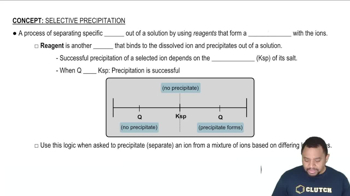
Precipitation reactions occur when two soluble salts react in solution to form an insoluble product, known as a precipitate. In this case, the reaction between H2SO4 and BaCl2 produces barium sulfate (BaSO4), which is insoluble in water and appears as a white precipitate. Understanding the solubility rules helps predict whether a precipitate will form when two solutions are mixed.
추천 영상:
가이드 코스
01:53
Selective Precipitation

Concentration and Molarity

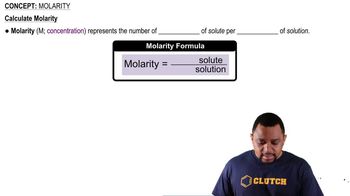
Molarity (M) is a measure of concentration defined as the number of moles of solute per liter of solution. In this scenario, both H2SO4 and BaCl2 are provided in molarity, which is crucial for calculating the amounts of reactants and products in the reaction. The concentration of the reactants influences the extent of the reaction and the amount of precipitate formed.
추천 영상:
가이드 코스
00:53
Molarity Concept

Le Chatelier's Principle

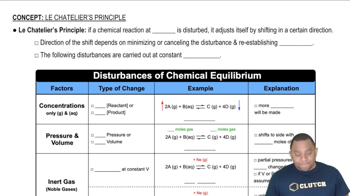
Le Chatelier's Principle states that if a system at equilibrium is disturbed, the system will shift in a direction that counteracts the disturbance. When more H2SO4 is added to the filtrate, the increased concentration of sulfate ions can drive the formation of more barium sulfate precipitate, as the system attempts to re-establish equilibrium by consuming the additional reactant.
추천 영상:
가이드 코스
07:32
Le Chatelier's Principle
관련 실천
교과서 질문
Elemental analysis of b@carotene, a dietary source of vitamin A, shows that it contains 10.51% H and 89.49% C. Dissolving 0.0250 g of b@carotene in 1.50 g of camphor gives a freezing- point depression of 1.17 °C. What are the molecular weight and formula of b@carotene? [Kf for camphor is 37.7 1°C kg2>mol.]
545
views
교과서 질문

Treatment of 1.385 g of an unknown metal M with an excess of aqueous HCl evolved a gas that was found to have a volume of 382.6 mL at 20.0 °C and 755 mm Hg pressure. Heating the reaction mixture to evaporate the water and remaining HCl then gave a white crystalline compound, MClx. After dis- solving the compound in 25.0 g of water, the melting point of the resulting solution was - 3.53 °C. (c) What is the molality of particles (ions) in the solution of MClx?

329
views
교과서 질문

Treatment of 1.385 g of an unknown metal M with an excess of aqueous HCl evolved a gas that was found to have a volume of 382.6 mL at 20.0 °C and 755 mm Hg pressure. Heating the reaction mixture to evaporate the water and remaining HCl then gave a white crystalline compound, MClx. After dissolving the compound in 25.0 g of water, the melting point of the resulting solution was - 3.53 °C. (b) What mass of MClx is formed? (a) How many moles of H2 gas are evolved?

1
views
교과서 질문

Treatment of 1.385 g of an unknown metal M with an excess of aqueous HCl evolved a gas that was found to have a volume of 382.6 mL at 20.0 °C and 755 mm Hg pressure. Heating the reaction mixture to evaporate the water and remaining HCl then gave a white crystalline compound, MClx. After dis- solving the compound in 25.0 g of water, the melting point of the resulting solution was - 3.53 °C. (e) What are the formula and molecular weight of MClx?

292
views