
Ch.13 - Solutions & Their Properties
McMurry - Chemistry 8th Edition
McMurry8th EditionChemistryISBN: 9781292336145당신이 사용하는 게 아니라요?교과서 변경
13장, 문제 146

The steroid hormone estradiol contains only C, H, and O; combustion analysis of a 3.47 mg sample yields 10.10 mg CO2 and 2.76 mg H2O. When dissolving 7.55 mg of estradiol in 0.500 g of camphor, the melting point of camphor is depressed by 2.10 °C. What is the molecular weight of estradiol, and what is a probable formula? [For camphor, Kf = 37.7 °C kg/mol.]

검증된 단계별 안내
1
Step 1: Determine the moles of carbon and hydrogen in the sample. Use the mass of CO2 to find the moles of carbon: \( \text{moles of C} = \frac{10.10 \text{ mg CO2}}{44.01 \text{ g/mol}} \times \frac{1 \text{ mol C}}{1 \text{ mol CO2}} \). Use the mass of H2O to find the moles of hydrogen: \( \text{moles of H} = \frac{2.76 \text{ mg H2O}}{18.02 \text{ g/mol}} \times \frac{2 \text{ mol H}}{1 \text{ mol H2O}} \).
Step 2: Calculate the mass of carbon and hydrogen in the sample. Convert moles of carbon to mass: \( \text{mass of C} = \text{moles of C} \times 12.01 \text{ g/mol} \). Convert moles of hydrogen to mass: \( \text{mass of H} = \text{moles of H} \times 1.008 \text{ g/mol} \).
Step 3: Determine the mass of oxygen in the sample. Subtract the mass of carbon and hydrogen from the total mass of the sample: \( \text{mass of O} = 3.47 \text{ mg} - \text{mass of C} - \text{mass of H} \).
Step 4: Calculate the moles of oxygen. Convert the mass of oxygen to moles: \( \text{moles of O} = \frac{\text{mass of O}}{16.00 \text{ g/mol}} \).
Step 5: Use the freezing point depression to find the molar mass of estradiol. Use the formula \( \Delta T_f = K_f \times m \), where \( m \) is the molality. Rearrange to find molality: \( m = \frac{\Delta T_f}{K_f} \). Then, use \( m = \frac{\text{moles of solute}}{\text{kg of solvent}} \) to find moles of estradiol, and calculate molar mass: \( \text{molar mass} = \frac{\text{mass of estradiol}}{\text{moles of estradiol}} \).

주요 개념

질문에 올바르게 답하기 위해 반드시 이해해야 하는 핵심 개념들은 다음과 같습니다.

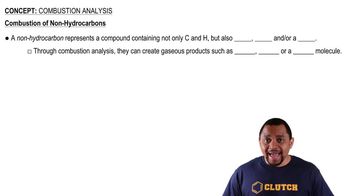
Combustion Analysis

Combustion analysis is a method used to determine the elemental composition of organic compounds. In this process, a sample is burned in excess oxygen, and the resulting products, typically CO2 and H2O, are measured. The masses of these products allow for the calculation of the amounts of carbon, hydrogen, and oxygen in the original sample, which is essential for determining the empirical formula of the compound.
추천 영상:
가이드 코스
01:29
Combustion of Non-Hydrocarbons

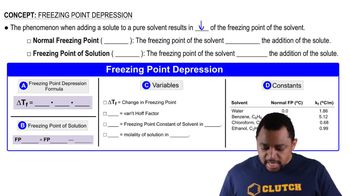
Freezing Point Depression

Freezing point depression is a colligative property that describes the lowering of a solvent's freezing point when a solute is added. The extent of this depression is directly proportional to the molality of the solute and is quantified using the formula ΔTf = Kf * m, where Kf is the freezing point depression constant of the solvent. This concept is crucial for calculating the molar mass of the solute, in this case, estradiol, based on the observed change in freezing point.
추천 영상:
가이드 코스
01:59
Freezing Point Depression

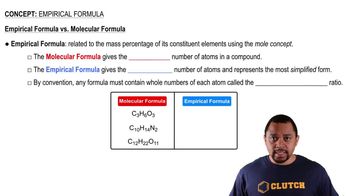
Molecular Weight and Empirical Formula

Molecular weight refers to the mass of a molecule calculated by summing the atomic weights of its constituent atoms. The empirical formula represents the simplest whole-number ratio of the elements in a compound. By determining the molecular weight from experimental data and the empirical formula from combustion analysis, one can deduce the molecular formula, which provides insight into the actual number of atoms of each element in a molecule of estradiol.
추천 영상:
가이드 코스
02:26
Empirical vs Molecular Formula
관련 실천
교과서 질문
Addition of 50.00 mL of 2.238 m H2SO4 1solution density = 1.1243 g>mL2 to 50.00 mL of 2.238 M BaCl2 gives a white precipitate. (b) If you filter the mixture and add more H2SO4 solution to the filtrate, would you obtain more precipitate? Explain.
368
views
교과서 질문
Elemental analysis of b@carotene, a dietary source of vitamin A, shows that it contains 10.51% H and 89.49% C. Dissolving 0.0250 g of b@carotene in 1.50 g of camphor gives a freezing- point depression of 1.17 °C. What are the molecular weight and formula of b@carotene? [Kf for camphor is 37.7 1°C kg2>mol.]
545
views
교과서 질문
Desert countries like Saudi Arabia have built reverse osmo-sis plants to produce freshwater from seawater. Assume that seawater has the composition 0.470 M NaCl and 0.068 M MgCl2 and that both compounds are completely dissociated. (b) If the reverse osmosis equipment can exert a maximum pressure of 100.0 atm at 25.0 °C, what is the maximum volume of freshwater that can be obtained from 1.00 L of seawater?
368
views
교과서 질문

Treatment of 1.385 g of an unknown metal M with an excess of aqueous HCl evolved a gas that was found to have a volume of 382.6 mL at 20.0 °C and 755 mm Hg pressure. Heating the reaction mixture to evaporate the water and remaining HCl then gave a white crystalline compound, MClx. After dis- solving the compound in 25.0 g of water, the melting point of the resulting solution was - 3.53 °C. (c) What is the molality of particles (ions) in the solution of MClx?

329
views
교과서 질문

Treatment of 1.385 g of an unknown metal M with an excess of aqueous HCl evolved a gas that was found to have a volume of 382.6 mL at 20.0 °C and 755 mm Hg pressure. Heating the reaction mixture to evaporate the water and remaining HCl then gave a white crystalline compound, MClx. After dissolving the compound in 25.0 g of water, the melting point of the resulting solution was - 3.53 °C. (b) What mass of MClx is formed? (a) How many moles of H2 gas are evolved?

1
views