
Ch.14 - Chemical Kinetics
McMurry - Chemistry 8th Edition
McMurry8th EditionChemistryISBN: 9781292336145당신이 사용하는 게 아니라요?교과서 변경
14장, 문제 114c

A proposed mechanism for the oxidation of nitric oxide to nitrogen dioxide was described in Problem 14.29. Another possible mechanism for this reaction is
(c) Relate the rate constant k to the rate constants for the elementary reactions.

검증된 단계별 안내
1
Identify the elementary reactions involved in the proposed mechanism.
Write the rate law for each elementary step based on its molecularity.
Determine the rate-determining step (RDS) of the mechanism, which is the slowest step.
Express the overall rate law in terms of the rate constant k and the rate constants of the elementary reactions.
Relate the rate constant k of the overall reaction to the rate constants of the elementary steps, considering the RDS and any fast equilibrium steps.

비슷한 문제에 대한 검증된 영상 답변:

이 영상 해법은 위 문제에 도움이 된다고 튜터들이 추천한 것입니다.
영상 길이:
5m

주요 개념

질문에 올바르게 답하기 위해 반드시 이해해야 하는 핵심 개념들은 다음과 같습니다.

Rate Constant (k)

The rate constant (k) is a proportionality factor in the rate law of a chemical reaction, indicating the speed at which the reaction occurs. It is specific to a particular reaction at a given temperature and is influenced by factors such as concentration and activation energy. Understanding k is essential for relating the overall reaction rate to the concentrations of reactants.
추천 영상:
가이드 코스
01:14
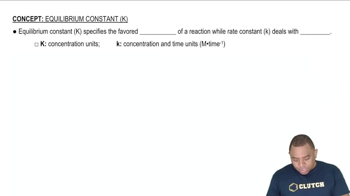
Equilibrium Constant K

Elementary Reactions

Elementary reactions are single-step processes that describe the direct transformation of reactants into products. Each elementary reaction has its own rate constant, which contributes to the overall rate of a complex reaction mechanism. Analyzing these steps helps in understanding how the overall reaction rate can be derived from the individual steps.
추천 영상:
가이드 코스
03:06
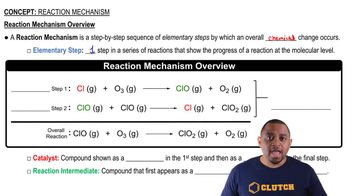
Reaction Mechanism Overview

Reaction Mechanism

A reaction mechanism is a detailed description of the step-by-step sequence of elementary reactions that lead to the overall transformation of reactants into products. It provides insight into the pathway and intermediates involved in a reaction, allowing chemists to relate the rate constants of individual steps to the overall rate constant of the reaction.
추천 영상:
가이드 코스
03:06
Reaction Mechanism Overview