
Ch.14 - Chemical Kinetics
McMurry - Chemistry 8th Edition
McMurry8th EditionChemistryISBN: 9781292336145당신이 사용하는 게 아니라요?교과서 변경
14장, 문제 114b

A proposed mechanism for the oxidation of nitric oxide to nitrogen dioxide was described in Problem 14.29. Another possible mechanism for this reaction is
(b) Show that this mechanism is consistent with the experimental rate law, Rate = k[NO4][O2].

검증된 단계별 안내
1
Identify the proposed mechanism and the intermediates involved. In this case, the mechanism should involve the reactants NO and O2, and possibly some intermediates.
Write the elementary steps of the mechanism based on the given information. Each step should involve either the reactants, products, or intermediates reacting with each other.
Determine the molecularity of each elementary step. This involves identifying whether each step is unimolecular (involving a single molecule), bimolecular (involving two molecules), or termolecular (involving three molecules).
Apply the steady-state approximation for any intermediates. This means assuming that the concentration of intermediates does not change significantly over the course of the reaction, allowing us to set their rate of formation equal to their rate of consumption.
Derive the rate law from the mechanism using the rate constants of the elementary steps and the steady-state concentrations of the intermediates. Compare this derived rate law to the given experimental rate law, Rate = k[NO4][O2], to check for consistency.

비슷한 문제에 대한 검증된 영상 답변:

이 영상 해법은 위 문제에 도움이 된다고 튜터들이 추천한 것입니다.
영상 길이:
5m

주요 개념

질문에 올바르게 답하기 위해 반드시 이해해야 하는 핵심 개념들은 다음과 같습니다.

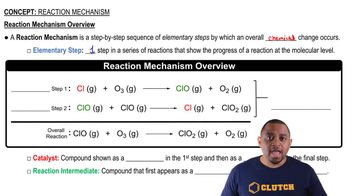
Reaction Mechanism

A reaction mechanism is a step-by-step description of the pathway through which reactants are converted into products. It outlines the individual elementary steps involved in a chemical reaction, including the formation and consumption of intermediates. Understanding the mechanism helps in predicting the rate of reaction and how different reactants influence the overall process.
추천 영상:
가이드 코스
03:06
Reaction Mechanism Overview

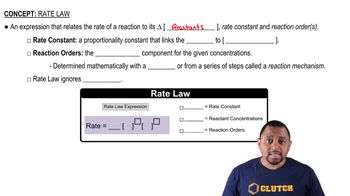
Rate Law

The rate law is an equation that relates the rate of a chemical reaction to the concentration of its reactants. It is typically expressed in the form Rate = k[A]^m[B]^n, where k is the rate constant, and m and n are the orders of the reaction with respect to reactants A and B. The rate law can be determined experimentally and is crucial for understanding how changes in concentration affect the reaction rate.
추천 영상:
가이드 코스
01:52
Rate Law Fundamentals

Elementary Steps and Rate-Determining Step

Elementary steps are individual reactions that occur in a mechanism, each with its own rate. The rate-determining step is the slowest step in the mechanism, which limits the overall reaction rate. Analyzing these steps allows chemists to derive the rate law and understand how the concentrations of reactants influence the speed of the reaction.
추천 영상:
가이드 코스
01:15
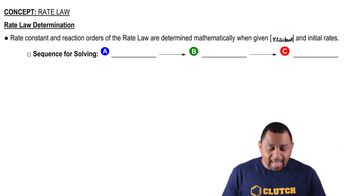
Rate Law Determination