Ch.14 - Chemical Kinetics
McMurry - Chemistry 8th Edition
McMurry8th EditionChemistryISBN: 9781292336145당신이 사용하는 게 아니라요?교과서 변경
14장, 문제 48b

Consider a reaction that occurs by the following mechanism:
A + BC → AC + B
AC + D → A + CD
The potential energy profile for this reaction is as follows:
(b) Write structural formulas for all species present at reaction stages 1–5. Identify each species as a reactant, product, catalyst, intermediate, or transition state.

검증된 단계별 안내
1
Step 1: Identify the species involved in each elementary step of the reaction mechanism.
Step 2: For the first step, A + BC → AC + B, identify A and BC as reactants, AC and B as products.
Step 3: For the second step, AC + D → A + CD, identify AC and D as reactants, A and CD as products.
Step 4: Determine the role of each species: A is a catalyst as it is regenerated, AC is an intermediate as it is formed and consumed, BC and D are reactants, B and CD are products.
Step 5: Consider the potential energy profile to identify transition states, which are high-energy states between reactants and products in each step.

비슷한 문제에 대한 검증된 영상 답변:

이 영상 해법은 위 문제에 도움이 된다고 튜터들이 추천한 것입니다.
영상 길이:
4m

주요 개념

질문에 올바르게 답하기 위해 반드시 이해해야 하는 핵심 개념들은 다음과 같습니다.

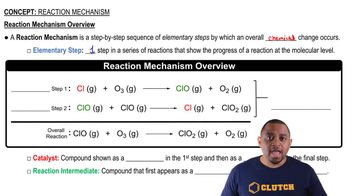
Reaction Mechanism

A reaction mechanism is a step-by-step description of the pathway taken by reactants to form products. It outlines the sequence of elementary reactions, including the formation of intermediates and transition states. Understanding the mechanism helps in predicting the rate and outcome of the reaction, as well as identifying the roles of different species involved.
추천 영상:
가이드 코스
03:06
Reaction Mechanism Overview

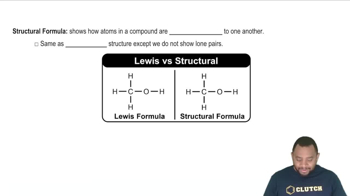
Structural Formulas

Structural formulas represent the arrangement of atoms within a molecule, showing how atoms are bonded together. They provide insight into the molecular geometry and functional groups present in each species. Writing structural formulas is essential for identifying the chemical nature of reactants, products, intermediates, and catalysts in a reaction.
추천 영상:
가이드 코스
01:00
Structural Formula

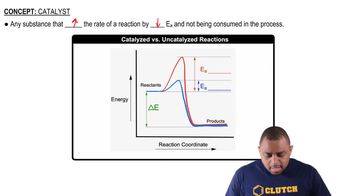
Catalysts and Intermediates

Catalysts are substances that increase the rate of a reaction without being consumed, while intermediates are transient species formed during the reaction that are not present in the final products. Recognizing these roles is crucial for understanding the overall reaction dynamics and energy changes, as intermediates often have distinct structural features that can be identified in the reaction mechanism.
추천 영상:
가이드 코스
01:59
Catalyzed vs. Uncatalyzed Reactions