Ch.14 - Chemical Kinetics
McMurry - Chemistry 8th Edition
McMurry8th EditionChemistryISBN: 9781292336145당신이 사용하는 게 아니라요?교과서 변경
14장, 문제 44

The following pictures represent the progress of a reaction in which two A molecules combine to give a more complex molecule A2, 2 AS A2. Three images showing the reaction progress of A molecules over time: 0, 1, and 2 minutes.
(b) What is the rate law?

검증된 단계별 안내
1
Step 1: Identify the reaction given: 2A -> A2.
Step 2: Observe the images provided, noting the number of A molecules at each time interval (0 min, 1 min, 2 min).
Step 3: Determine the change in concentration of A molecules over time by counting the number of A molecules at each time interval.
Step 4: Use the rate law expression for a reaction of the form 2A -> A2, which is rate = k[A]^2, where k is the rate constant.
Step 5: Conclude that the rate law for this reaction is rate = k[A]^2, indicating a second-order reaction with respect to A.

비슷한 문제에 대한 검증된 영상 답변:

이 영상 해법은 위 문제에 도움이 된다고 튜터들이 추천한 것입니다.
영상 길이:
3m

주요 개념

질문에 올바르게 답하기 위해 반드시 이해해야 하는 핵심 개념들은 다음과 같습니다.

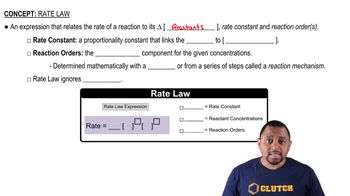
Rate Law

The rate law is an equation that relates the rate of a chemical reaction to the concentration of its reactants. It is typically expressed in the form rate = k[A]^m[B]^n, where k is the rate constant, and m and n are the orders of the reaction with respect to reactants A and B, respectively. Understanding the rate law is crucial for predicting how changes in concentration affect the reaction rate.
추천 영상:
가이드 코스
01:52
Rate Law Fundamentals

Reaction Order

Reaction order refers to the power to which the concentration of a reactant is raised in the rate law. It indicates how the rate of reaction is affected by the concentration of that reactant. For example, a first-order reaction means that the rate is directly proportional to the concentration of one reactant, while a second-order reaction indicates that the rate is proportional to the square of the concentration of that reactant.
추천 영상:
가이드 코스
00:36
Average Bond Order

Molecularity

Molecularity is the number of reactant molecules involved in an elementary reaction step. It can be unimolecular (one molecule), bimolecular (two molecules), or termolecular (three molecules). In the context of the given reaction, where two A molecules combine to form A2, the reaction is bimolecular, which is important for determining the rate law and understanding the mechanism of the reaction.
추천 영상:
가이드 코스
02:38
Molecular Polarity
관련 실천
교과서 질문
The relative rates of the reaction A + B S AB in vessels (1)–(3) are 4:4:1. Red spheres represent A molecules, and blue spheres represent B molecules. (1)-(3)

(a) What is the order of the reaction in A and B?
510
views

교과서 질문
What is the molecularity of each of the following elementary reactions? (a)

(b)

(c)

942
views
교과서 질문
Consider the first-order reaction AS B in which A molecules (red spheres) are converted to B molecules (blue spheres).

(a) Given the pictures at t = 0 min and t = 1 min, draw pictures that show the number of A and B molecules present at t = 2 min and t = 3 min.
766
views
교과서 질문

Consider a reaction that occurs by the following mechanism:

A + BC → AC + B

AC + D → A + CD

The potential energy profile for this reaction is as follows:

(b) Write structural formulas for all species present at reaction stages 1–5. Identify each species as a reactant, product, catalyst, intermediate, or transition state.

685
views
교과서 질문

The following pictures represent the progress of the reaction AS B in which A molecules (red spheres) are converted to B molecules (blue spheres).

(c) Suppose that each sphere represents 6.0⨉1021 molecules and that the volume of the container is 1.0 L. What is the rate constant for the reaction in the usual units?

519
views
교과서 질문

The following pictures represent the progress of the reaction AS B in which A molecules (red spheres) are converted to B molecules (blue spheres).

(b) Draw a picture that shows the number of A and B molecules present at t = 3 min.

620
views
1
rank