Ch.14 - Chemical Kinetics
McMurry - Chemistry 8th Edition
McMurry8th EditionChemistryISBN: 9781292336145당신이 사용하는 게 아니라요?교과서 변경
14장, 문제 48c

Consider a reaction that occurs by the following mechanism:
A + BC → AC + B
AC + D → A + CD
The potential energy profile for this reaction is as follows:
(c) Which of the two steps in the mechanism is the rate-determining step? Write the rate law for the overall reaction.

검증된 단계별 안내
1
Identify the rate-determining step by analyzing the potential energy profile. The rate-determining step is the slowest step in the reaction mechanism, typically associated with the highest energy barrier or transition state.
Compare the energy barriers of the two steps: A + BC → AC + B and AC + D → A + CD. The step with the higher energy barrier is the rate-determining step.
Once the rate-determining step is identified, write the rate law based on this step. The rate law is determined by the reactants involved in the rate-determining step.
For the rate-determining step, use the stoichiometry of the reactants to express the rate law. If the step is A + BC → AC + B, the rate law would be rate = k[A][BC].
Combine the information from the rate-determining step to express the overall rate law for the reaction, ensuring it reflects the slowest step's reactants.

비슷한 문제에 대한 검증된 영상 답변:

이 영상 해법은 위 문제에 도움이 된다고 튜터들이 추천한 것입니다.
영상 길이:
2m

주요 개념

질문에 올바르게 답하기 위해 반드시 이해해야 하는 핵심 개념들은 다음과 같습니다.

Rate-Determining Step

The rate-determining step (RDS) is the slowest step in a reaction mechanism that dictates the overall reaction rate. It acts as a bottleneck, meaning that the speed of the entire reaction cannot exceed the speed of this step. Identifying the RDS is crucial for understanding how changes in conditions affect the reaction rate.
추천 영상:
가이드 코스
01:15
Rate Law Determination

Reaction Mechanism

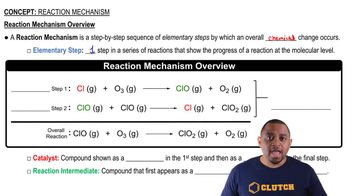
A reaction mechanism is a detailed description of the individual steps that occur during a chemical reaction. Each step involves the breaking and forming of bonds, and the sequence of these steps can influence the overall rate and products of the reaction. Understanding the mechanism helps in predicting the rate law and the effect of catalysts.
추천 영상:
가이드 코스
03:06
Reaction Mechanism Overview

Rate Law

The rate law expresses the relationship between the rate of a chemical reaction and the concentration of its reactants. It is typically formulated as rate = k[A]^m[B]^n, where k is the rate constant, and m and n are the orders of the reaction with respect to reactants A and B. The rate law can be derived from the rate-determining step and provides insight into how changes in concentration affect the reaction rate.
추천 영상:
가이드 코스
01:52
Rate Law Fundamentals
관련 실천
교과서 질문
The relative rates of the reaction A + B S AB in vessels (1)–(3) are 4:4:1. Red spheres represent A molecules, and blue spheres represent B molecules. (1)-(3)

(a) What is the order of the reaction in A and B?
510
views

교과서 질문
What is the molecularity of each of the following elementary reactions? (a)

(b)

(c)

942
views
교과서 질문
Draw a plausible transition state for the bimolecular reaction of nitric oxide with ozone. Use dashed lines to indicate the atoms that are weakly linked together in the transition state. NO(g) + O3(g) NO2(g) + O2(g)

543
views
교과서 질문

Consider a reaction that occurs by the following mechanism:

A + BC → AC + B

AC + D → A + CD

The potential energy profile for this reaction is as follows:

(d) Is the reaction endothermic or exothermic? Add labels to the diagram that show the values of the energy of reaction ΔE and the activation energy Ea for the overall reaction.

523
views
교과서 질문

Consider a reaction that occurs by the following mechanism:

A + BC → AC + B

AC + D → A + CD

The potential energy profile for this reaction is as follows:

(b) Write structural formulas for all species present at reaction stages 1–5. Identify each species as a reactant, product, catalyst, intermediate, or transition state.

685
views
교과서 질문
Use the information in Table 14.1 and Figure 14.1 to estimate the instantaneous rate of appearance of NO2 at t = 350 s by calculating the average rate of appearance of NO2 over the following time intervals centered on t = 350 s. (a) 0 to 700 s (b) 100 to 600 s (c) 200 to 500 s (d) 300 to 400 s Which is the best estimate, and why?
684
views