Ch.14 - Chemical Kinetics
McMurry - Chemistry 8th Edition
McMurry8th EditionChemistryISBN: 9781292336145당신이 사용하는 게 아니라요?교과서 변경
14장, 문제 83

Consider the following concentration–time data for the decomposition reaction AB → A + B. (c) What is the time (in minutes) when the AB concentration reaches a value of 0.0250 M?
검증된 단계별 안내
1
Identify the order of the reaction by analyzing the concentration-time data provided. This can be done by plotting the data and determining which plot (zero-order, first-order, or second-order) yields a straight line.
Once the order of the reaction is determined, use the appropriate integrated rate law equation. For a first-order reaction, the equation is: ln(C)=-kt+ln(C0), where C is the concentration at time t, C0 is the initial concentration, and k is the rate constant.
Determine the rate constant k using the slope of the line from the plot corresponding to the reaction order. For a first-order reaction, the slope is -k.
Substitute the known values into the integrated rate law equation. Use the initial concentration C0, the rate constant k, and the target concentration 0.0250M to solve for the time t.
Calculate the time t using the rearranged equation: t=ln(C/C0)-k. This will give you the time in minutes when the concentration of AB reaches 0.0250M.

주요 개념

질문에 올바르게 답하기 위해 반드시 이해해야 하는 핵심 개념들은 다음과 같습니다.

Reaction Kinetics

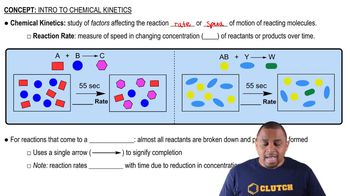
Reaction kinetics is the study of the rates of chemical processes. It involves understanding how different factors, such as concentration, temperature, and catalysts, affect the speed of a reaction. In this context, knowing the kinetics of the decomposition of AB into A and B is essential to determine how the concentration of AB changes over time.
추천 영상:
가이드 코스
03:06
Chemical Kinetics

Concentration Units

Concentration is a measure of the amount of a substance in a given volume of solution, typically expressed in molarity (M), which is moles of solute per liter of solution. Understanding how to interpret and manipulate concentration values is crucial for solving problems related to chemical reactions, such as determining when the concentration of AB reaches a specific value.
추천 영상:

Integrated Rate Laws

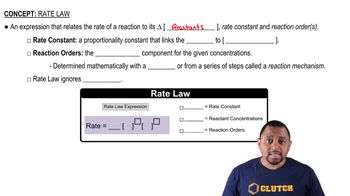
Integrated rate laws relate the concentration of reactants to time for a given reaction order. For a first-order reaction, for example, the integrated rate law can be used to calculate the concentration of a reactant at any time. In this case, applying the appropriate integrated rate law will allow us to find the time when the concentration of AB reaches 0.0250 M.
추천 영상:
가이드 코스
01:52
Rate Law Fundamentals

교과서 질문

Consider the following concentration–time data for the decomposition reaction AB → A + B.

(b) What is the molarity of AB after a reaction time of 192 min?

719
views
교과서 질문
You wish to determine the reaction order and rate constant for the following thermal decomposition reaction: AB2 S 1>2 A2 + B2 (c) Describe how you would determine the value of the rate constant.
611
views
교과서 질문
The decomposition of N2O5 is a first-order reaction. At 25 °C, it takes 5.2 h for the concentration to drop from 0.120 M to 0.060 M. How many hours does it take for the concentration to drop from 0.030 M to 0.015 M? From 0.480 M to 0.015 M?
2078
views
교과서 질문
Trans-cycloheptene 1C7H122, a strained cyclic hydrocarbon, converts to cis-cycloheptene at low temperatures. This molecular rearrangement is a second-order process with a rate constant of 0.030 M-1 s-1 at 60 °C. If the initial concentration of trans-cycloheptene is 0.035 M: (c) What is the half-life of trans-cycloheptene at an initial concentration of 0.075 M?
349
views
교과서 질문

Consider the following concentration–time data for the decomposition reaction AB → A + B.

(a) Determine the order of the reaction and the value of the rate constant.

455
views
