
Ch.15 - Chemical Equilibrium
McMurry - Chemistry 8th Edition
McMurry8th EditionChemistryISBN: 9781292336145당신이 사용하는 게 아니라요?교과서 변경
15장, 문제 41

Consider the interconversion of A molecules (red spheres) and B molecules (blue spheres) according to the reaction A ∆ B. Each of the series of pictures at the right represents a separate experiment in which time increases from left to right: (b) What is the value of the equilibrium constant Kc for the reaction A ∆ B?Series of images showing the interconversion of red A and blue B molecules over time.

검증된 단계별 안내
1
Count the number of A molecules (red spheres) and B molecules (blue spheres) in each image at equilibrium.
Calculate the concentration of A and B molecules for each experiment by dividing the number of molecules by the total number of molecules in the system.
Use the equilibrium concentrations to determine the equilibrium constant Kc for each experiment using the formula Kc = [B]/[A].
Average the Kc values obtained from each experiment to find the overall equilibrium constant for the reaction.
Verify the consistency of the calculated Kc values across different experiments to ensure accuracy.

비슷한 문제에 대한 검증된 영상 답변:

이 영상 해법은 위 문제에 도움이 된다고 튜터들이 추천한 것입니다.
영상 길이:
3m
도움이 되었나요?

주요 개념

질문에 올바르게 답하기 위해 반드시 이해해야 하는 핵심 개념들은 다음과 같습니다.

Equilibrium Constant (Kc)

The equilibrium constant (Kc) is a numerical value that expresses the ratio of the concentrations of products to reactants at equilibrium for a given chemical reaction. For the reaction A ⇌ B, Kc is calculated as [B]/[A], where [B] and [A] are the molar concentrations of B and A, respectively. A larger Kc indicates a greater concentration of products at equilibrium, while a smaller Kc suggests a higher concentration of reactants.
추천 영상:
가이드 코스
03:20
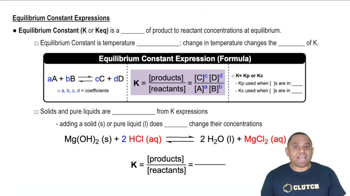
Equilibrium Constant Expressions

Dynamic Equilibrium

Dynamic equilibrium occurs in a reversible reaction when the rate of the forward reaction equals the rate of the reverse reaction, resulting in constant concentrations of reactants and products over time. In the context of the reaction A ⇌ B, this means that the interconversion between A and B continues, but the overall concentrations remain unchanged. Understanding this concept is crucial for determining the equilibrium constant.
추천 영상:
가이드 코스
01:18
Chemical Equilibrium Example

Concentration Changes Over Time

In the series of images, the changes in the number of red (A) and blue (B) molecules over time illustrate how the concentrations of reactants and products evolve as the reaction progresses. By analyzing these changes, one can determine the point at which the system reaches equilibrium, which is essential for calculating Kc. Observing the relative amounts of A and B at equilibrium allows for the accurate determination of the equilibrium constant.
추천 영상:
가이드 코스
02:10
Concentration Changes and Rate Law Example