Ch.15 - Chemical Equilibrium
McMurry - Chemistry 8th Edition
McMurry8th EditionChemistryISBN: 9781292336145당신이 사용하는 게 아니라요?교과서 변경
15장, 문제 43

The reaction A2 + B ∆ A + AB has an equilibrium con-stant Kc = 2. The following pictures represent reaction mix- tures that contain A atoms (red), B atoms (blue), and A2 and AB molecules. Three reaction mixtures showing red A atoms, blue B atoms, and A2 and AB molecules for equilibrium analysis.
(a) Which reaction mixture is at equilibrium?

검증된 단계별 안내
1
Step 1: Identify the number of A2, B, A, and AB molecules in each reaction mixture.
Step 2: Calculate the concentration of each species in each mixture. Assume the volume is constant and the same for all mixtures.
Step 3: Use the equilibrium constant expression for the reaction, Kc = [A][AB] / [A2][B], to calculate the equilibrium constant for each mixture.
Step 4: Compare the calculated equilibrium constant for each mixture with the given Kc value of 2.
Step 5: Determine which mixture has a calculated equilibrium constant closest to 2, indicating it is at equilibrium.

비슷한 문제에 대한 검증된 영상 답변:

이 영상 해법은 위 문제에 도움이 된다고 튜터들이 추천한 것입니다.
영상 길이:
6m

주요 개념

질문에 올바르게 답하기 위해 반드시 이해해야 하는 핵심 개념들은 다음과 같습니다.

Chemical Equilibrium

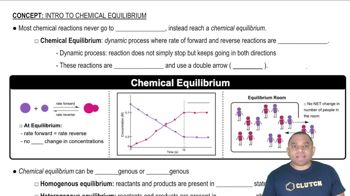
Chemical equilibrium occurs when the rates of the forward and reverse reactions are equal, resulting in constant concentrations of reactants and products over time. In this state, the system appears static, but molecular activity continues. Understanding equilibrium is crucial for analyzing reaction mixtures and determining which mixture is at equilibrium.
추천 영상:
가이드 코스
04:21
Chemical Equilibrium Concepts

Equilibrium Constant (Kc)

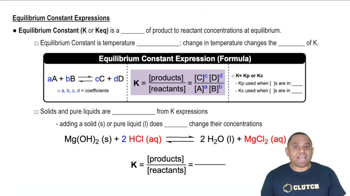
The equilibrium constant (Kc) quantifies the ratio of the concentrations of products to reactants at equilibrium for a given reaction at a specific temperature. For the reaction A2 + B ⇌ A + AB, Kc = [A][AB]/[A2][B]. A Kc value of 2 indicates that at equilibrium, the concentration of products is twice that of the reactants, guiding the analysis of the reaction mixtures.
추천 영상:
가이드 코스
03:20
Equilibrium Constant Expressions

Molecular Representation

Molecular representation visually depicts the composition of a reaction mixture, showing the types and quantities of molecules present. In the provided images, red spheres represent A atoms, blue spheres represent B atoms, and the combinations represent A2 and AB molecules. Analyzing these representations helps identify which mixture aligns with the equilibrium condition based on the Kc value.
추천 영상:
가이드 코스
02:38
Molecular Polarity
관련 실천
교과서 질문

If Kc = 7.5×10⁻⁹ at 1000 K for the reaction N2(g) + O2(g) → 2 NO(g), give the value of Kc at 1000 K for the reaction

(b) NO(g) → 1/2 N2(g) + 1/2 O2(g)

89
views

교과서 질문
Consider the interconversion of A molecules (red spheres) and B molecules (blue spheres) according to the reaction A ∆ B. Each of the series of pictures at the right represents a separate experiment in which time increases from left to right: (b) What is the value of the equilibrium constant Kc for the reaction A ∆ B?

577
views
교과서 질문
The following pictures represent the composition of the equi- librium mixture for the reaction A + B ∆ AB at 300 K and at 400 K.

Is the reaction exothermic or endothermic? Explain using Le Châtelier's principle.
380
views
교과서 질문
Consider the reaction A + B ∆ AB. The vessel on the right contains an equilibrium mixture of A molecules (red spheres), B molecules (blue spheres), and AB molecules. If the stopcock is opened and the contents of the two vessels are allowed to mix, will the reaction go in the forward or reverse direction? Explain.

554
views
교과서 질문

The reaction 2 AsH31g2 ∆ As21g2 + 3 H21g2 has Kp =

7.2 * 107 at 1073 K. At the same temperature, what is Kp

for each of the following reactions?

(c) 9 H21g2 + 3 As21g2 ∆ 6 AsH31g2

98
views
교과서 질문

The following pictures represent the initial state and the equilibrium state for the reaction of A2 molecules (red) with B atoms (blue) to give AB molecules. (a) Write a balanced chemical equation for the reaction.

509
views