

Ch.15 - Chemical Equilibrium
McMurry - Chemistry 8th Edition
McMurry8th EditionChemistryISBN: 9781292336145당신이 사용하는 게 아니라요?교과서 변경
15장, 문제 15.62c

The reaction 2 AsH31g2 ∆ As21g2 + 3 H21g2 has Kp =
7.2 * 107 at 1073 K. At the same temperature, what is Kp
for each of the following reactions?
(c) 9 H21g2 + 3 As21g2 ∆ 6 AsH31g2

검증된 단계별 안내
1
Identify the relationship between the given reaction and the target reaction. The target reaction can be derived by reversing the given reaction and then multiplying it by 3.
Write the expression for the equilibrium constant (Kp) for the given reaction: Kp = [As2]^2 * [H2]^3 / [AsH3]^2.
For the reversed reaction, the equilibrium constant expression will be the reciprocal of the original reaction's Kp. Thus, Kp' = 1 / Kp.
Since the target reaction is 3 times the reversed reaction, raise the Kp' to the power of 3 to find the new Kp for the target reaction: Kp'' = (Kp')^3.
Substitute the value of Kp from the given reaction into the expression derived in step 4 to find the Kp for the target reaction.

비슷한 문제에 대한 검증된 영상 답변:

이 영상 해법은 위 문제에 도움이 된다고 튜터들이 추천한 것입니다.
영상 길이:
4m

주요 개념

질문에 올바르게 답하기 위해 반드시 이해해야 하는 핵심 개념들은 다음과 같습니다.

Equilibrium Constant (Kp)

The equilibrium constant, Kp, is a numerical value that expresses the ratio of the partial pressures of the products to the reactants at equilibrium for a given reaction at a specific temperature. It is derived from the balanced chemical equation and indicates the extent to which a reaction favors products or reactants. A larger Kp value suggests a greater concentration of products at equilibrium.
추천 영상:
가이드 코스
03:20
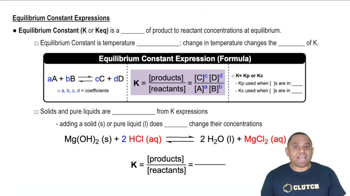
Equilibrium Constant Expressions

Reaction Stoichiometry

Reaction stoichiometry refers to the quantitative relationship between the reactants and products in a chemical reaction, as represented by the coefficients in a balanced equation. This concept is crucial for determining how changes in the amounts of reactants or products affect the equilibrium position and the calculation of equilibrium constants for related reactions.
추천 영상:
가이드 코스
01:16
Stoichiometry Concept

Reverse Reaction and Kp Relationship

The equilibrium constant for a reverse reaction is the reciprocal of the equilibrium constant for the forward reaction. If a reaction is reversed, the Kp value must be inverted to reflect the new direction of the reaction. This relationship is essential for calculating Kp for different but related reactions, as seen in the provided question.
추천 영상:
가이드 코스
02:18
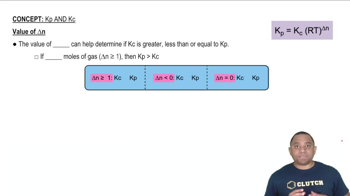
Kp vs Kc Relationship