Beginning with the equations that relate E°, ∆G°, and K, show that ∆G° is negative and K 7 1 for a reaction that has a positive value of E°
검증된 단계별 안내
1
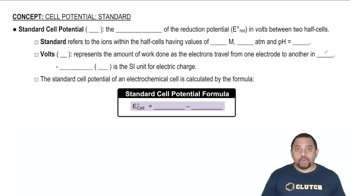
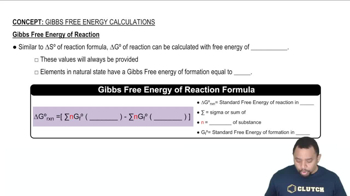
Start by recalling the relationship between the standard cell potential (E°), the standard Gibbs free energy change (∆G°), and the equilibrium constant (K). The equation is: ∆G° = -nFE°, where n is the number of moles of electrons transferred in the reaction and F is the Faraday constant.
Understand that if E° is positive, then -nFE° will be negative, indicating that ∆G° is negative. This implies that the reaction is spontaneous under standard conditions.
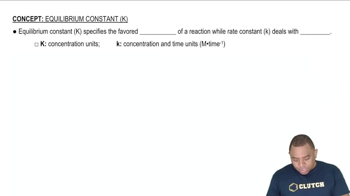
Next, consider the relationship between ∆G° and the equilibrium constant K, given by the equation: ∆G° = -RT ln K, where R is the universal gas constant and T is the temperature in Kelvin.
Since ∆G° is negative when E° is positive, substitute this into the equation: -RT ln K < 0. This implies that ln K > 0.
Finally, if ln K > 0, then K > 1. This shows that for a reaction with a positive E°, ∆G° is negative and K is greater than 1, indicating a spontaneous reaction with a tendency to favor the formation of products.
비슷한 문제에 대한 검증된 영상 답변:
이 영상 해법은 위 문제에 도움이 된다고 튜터들이 추천한 것입니다.
영상 길이:
3m
영상 재생:
0 댓글
주요 개념
질문에 올바르게 답하기 위해 반드시 이해해야 하는 핵심 개념들은 다음과 같습니다.
Gibbs Free Energy (∆G°)
Gibbs Free Energy (∆G°) is a thermodynamic potential that measures the maximum reversible work obtainable from a thermodynamic process at constant temperature and pressure. A negative value of ∆G° indicates that a reaction is spontaneous, meaning it can occur without external energy input. This concept is crucial for understanding the favorability of chemical reactions.
Standard Electrode Potential (E°) is a measure of the tendency of a chemical species to be reduced, expressed in volts. A positive E° value suggests that the reaction is favorable and can drive the formation of products. The relationship between E° and ∆G° is given by the equation ∆G° = -nFE°, where n is the number of moles of electrons transferred and F is Faraday's constant.
The equilibrium constant (K) quantifies the ratio of the concentrations of products to reactants at equilibrium for a given reaction. A K value greater than 1 indicates that products are favored at equilibrium, aligning with a spontaneous reaction. The relationship between K and ∆G° is expressed by the equation ∆G° = -RT ln(K), where R is the gas constant and T is the temperature in Kelvin.


 검증된 단계별 안내
 01:51
01:51