
Ch.19 - Electrochemistry
McMurry - Chemistry 8th Edition
McMurry8th EditionChemistryISBN: 9781292336145당신이 사용하는 게 아니라요?교과서 변경
19장, 문제 107

What is the pH of the solution in the cathode compartment of the following cell if the measured cell potential at 25 °C is 0.17 V?

검증된 단계별 안내
1
Identify the half-reactions occurring at the anode and cathode. For a typical electrochemical cell, the anode is where oxidation occurs, and the cathode is where reduction occurs.
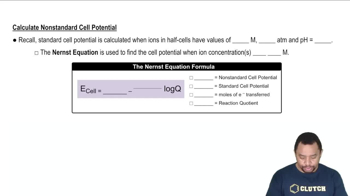
Use the Nernst equation to relate the cell potential to the concentrations of the reactants and products. The Nernst equation is given by: \(E = E^0 - \frac{RT}{nF} \ln Q\), where \(E\) is the cell potential, \(E^0\) is the standard cell potential, \(R\) is the gas constant, \(T\) is the temperature in Kelvin, \(n\) is the number of moles of electrons transferred, \(F\) is Faraday's constant, and \(Q\) is the reaction quotient.
Determine the standard cell potential, \(E^0\), for the cell by using standard reduction potentials from a table. The standard cell potential is calculated as \(E^0_{\text{cell}} = E^0_{\text{cathode}} - E^0_{\text{anode}}\).
Calculate the reaction quotient, \(Q\), using the concentrations of the species involved in the half-reactions. For the cathode compartment, this will involve the concentration of H+ ions, which is related to the pH by \([H^+] = 10^{-\text{pH}}\).
Rearrange the Nernst equation to solve for the pH of the solution in the cathode compartment. Substitute the known values into the equation and solve for the pH.

비슷한 문제에 대한 검증된 영상 답변:

이 영상 해법은 위 문제에 도움이 된다고 튜터들이 추천한 것입니다.
영상 길이:
4m

주요 개념

질문에 올바르게 답하기 위해 반드시 이해해야 하는 핵심 개념들은 다음과 같습니다.

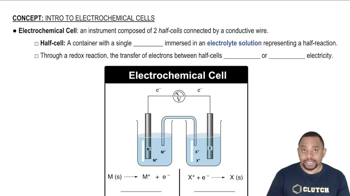
Electrochemical Cells

Electrochemical cells consist of two half-cells where oxidation and reduction reactions occur. The cell potential, measured in volts, indicates the driving force behind these reactions. In this context, the cathode is where reduction takes place, and understanding the overall cell reaction is crucial for determining the pH of the solution.
추천 영상:
가이드 코스
02:46
Electrochemical Cells

Nernst Equation

The Nernst equation relates the cell potential to the concentrations of the reactants and products involved in the electrochemical reaction. It allows for the calculation of the cell potential under non-standard conditions, which is essential for determining the pH in the cathode compartment based on the measured potential.
추천 영상:
가이드 코스
01:17
The Nernst Equation

pH and Hydrogen Ion Concentration

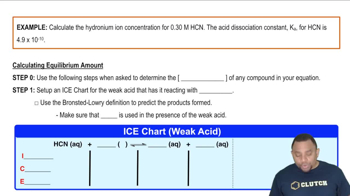
pH is a measure of the hydrogen ion concentration in a solution, defined as the negative logarithm of the hydrogen ion activity. In electrochemical cells, the pH can influence the cell potential and is directly related to the concentration of species involved in the half-reactions. Understanding this relationship is key to solving the question regarding the pH in the cathode compartment.
추천 영상:
가이드 코스
06:25
Hydronium Ion Concentration Example