Copper reduces dilute nitric acid to nitric oxide (NO) but reduces concentrated nitric acid to nitrogen dioxide (NO2): Assuming that [Cu2+] = 0.10 M and that the partial pressures of NO and NO2 are 1.0 * 10-3 atm, calculate the potential (E) for reactions (1) and (2) at 25 °C and show which reaction has the greater thermodynamic tendency to occur when the concentration of HNO3 is
(a) 1.0 M
검증된 단계별 안내
1
Step 1: Write the balanced chemical equations for the reactions of copper with dilute and concentrated nitric acid. For dilute nitric acid: \(3Cu + 8HNO_3 → 3Cu(NO_3)_2 + 2NO + 4H_2O\). For concentrated nitric acid: \(Cu + 4HNO_3 → Cu(NO_3)_2 + 2NO_2 + 2H_2O\).
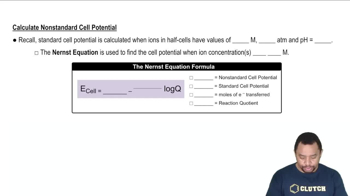
Step 2: Use the Nernst equation to calculate the potential for each reaction. The Nernst equation is given by \(E = E^0 - \frac{RT}{nF} \ln Q\), where \(E^0\) is the standard electrode potential, \(R\) is the gas constant, \(T\) is the temperature in Kelvin, \(n\) is the number of moles of electrons transferred, \(F\) is the Faraday constant, and \(Q\) is the reaction quotient.
Step 3: Calculate the reaction quotient, \(Q\), for each reaction. For the reaction with dilute nitric acid, \(Q = \frac{[Cu^{2+}]^3 [NO]^2}{[HNO_3]^8}\). For the reaction with concentrated nitric acid, \(Q = \frac{[Cu^{2+}] [NO_2]^2}{[HNO_3]^4}\).
Step 4: Substitute the values of \(E^0\), \(R\), \(T\), \(n\), \(F\), and \(Q\) into the Nernst equation for each reaction. Use the given concentrations and partial pressures, and assume standard conditions for any missing values (e.g., standard electrode potentials).
Step 5: Compare the calculated potentials, \(E\), for both reactions. The reaction with the higher potential has the greater thermodynamic tendency to occur under the given conditions.
비슷한 문제에 대한 검증된 영상 답변:
이 영상 해법은 위 문제에 도움이 된다고 튜터들이 추천한 것입니다.
영상 길이:
44s
영상 재생:
0 댓글
주요 개념
질문에 올바르게 답하기 위해 반드시 이해해야 하는 핵심 개념들은 다음과 같습니다.
Electrochemical Cell and Standard Electrode Potential
An electrochemical cell converts chemical energy into electrical energy through redox reactions. The standard electrode potential (E°) is a measure of the tendency of a chemical species to be reduced, with higher values indicating a greater likelihood of reduction. Understanding these potentials is crucial for calculating the overall cell potential (E) under non-standard conditions, such as varying concentrations of reactants.
The Nernst equation relates the cell potential (E) to the standard electrode potential (E°) and the concentrations of the reactants and products. It is expressed as E = E° - (RT/nF) ln(Q), where Q is the reaction quotient. This equation allows for the calculation of the potential under non-standard conditions, which is essential for determining the favorability of the reactions involving copper and nitric acid.
Redox reactions involve the transfer of electrons between species, resulting in oxidation and reduction processes. The reaction quotient (Q) is a ratio of the concentrations of products to reactants at any given moment, which helps in assessing the direction of the reaction. In this context, understanding how the concentrations of NO and NO2 affect Q is vital for determining which reaction is more thermodynamically favorable under the specified conditions.


 검증된 단계별 안내
 01:27
01:27