Ch.19 - Electrochemistry
McMurry - Chemistry 8th Edition
McMurry8th EditionChemistryISBN: 9781292336145당신이 사용하는 게 아니라요?교과서 변경
19장, 문제 113

Calculate the equilibrium constant at 25 °C for the reaction

검증된 단계별 안내
1
Step 1: Identify the balanced chemical equation for the reaction. This will help you determine the stoichiometry of the reactants and products involved.
Step 2: Write the expression for the equilibrium constant, K, using the balanced chemical equation. The general form is K = [products]^coefficients / [reactants]^coefficients, where the concentrations are at equilibrium.
Step 3: Determine the standard Gibbs free energy change (ΔG°) for the reaction at 25 °C. This can be found using tabulated standard Gibbs free energies of formation for the reactants and products.
Step 4: Use the relationship between the equilibrium constant and Gibbs free energy change: ΔG° = -RT ln(K), where R is the universal gas constant (8.314 J/mol·K) and T is the temperature in Kelvin. Rearrange this equation to solve for K.
Step 5: Substitute the values for ΔG°, R, and T into the equation from Step 4 to calculate the equilibrium constant, K, for the reaction at 25 °C.

주요 개념

질문에 올바르게 답하기 위해 반드시 이해해야 하는 핵심 개념들은 다음과 같습니다.

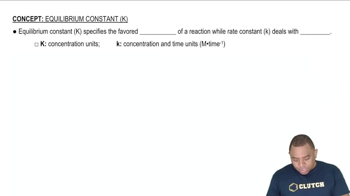
Equilibrium Constant (K)

The equilibrium constant (K) is a numerical value that expresses the ratio of the concentrations of products to reactants at equilibrium for a given chemical reaction at a specific temperature. It provides insight into the extent of the reaction; a large K indicates that products are favored, while a small K suggests that reactants are favored.
추천 영상:
가이드 코스
01:14
Equilibrium Constant K

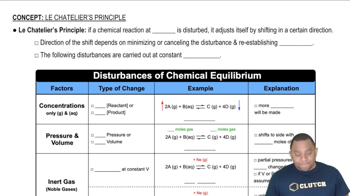
Le Chatelier's Principle

Le Chatelier's Principle states that if a dynamic equilibrium is disturbed by changing the conditions, the system will adjust itself to counteract the change and restore a new equilibrium. This principle helps predict how changes in concentration, pressure, or temperature will affect the position of equilibrium and, consequently, the value of K.
추천 영상:
가이드 코스
07:32
Le Chatelier's Principle

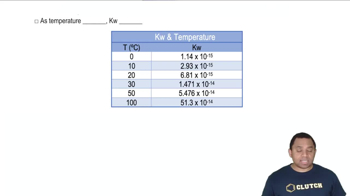
Temperature Dependence of K

The equilibrium constant is temperature-dependent, meaning its value changes with temperature. For exothermic reactions, increasing temperature typically decreases K, while for endothermic reactions, increasing temperature increases K. Understanding this relationship is crucial for calculating K at different temperatures, such as the specified 25 °C.
추천 영상:
가이드 코스
01:24
Kw Temperature Dependence