Ch.19 - Electrochemistry
McMurry - Chemistry 8th Edition
McMurry8th EditionChemistryISBN: 9781292336145당신이 사용하는 게 아니라요?교과서 변경
19장, 문제 112

Calculate the equilibrium constant at 25 °C for the reaction

검증된 단계별 안내
1
Step 1: Identify the balanced chemical equation for the reaction. This will help you determine the stoichiometry of the reactants and products involved.
Step 2: Write the expression for the equilibrium constant, K, using the balanced chemical equation. The general form is K = [products]^coefficients / [reactants]^coefficients, where the concentrations are at equilibrium.
Step 3: Determine the standard Gibbs free energy change (ΔG°) for the reaction at 25 °C. This can be done using tabulated standard Gibbs free energies of formation for the reactants and products.
Step 4: Use the relationship between the equilibrium constant and the Gibbs free energy change: ΔG° = -RT ln(K), where R is the universal gas constant (8.314 J/mol·K) and T is the temperature in Kelvin (298 K for 25 °C).
Step 5: Rearrange the equation from Step 4 to solve for the equilibrium constant, K, by calculating K = e^(-ΔG°/RT).

주요 개념

질문에 올바르게 답하기 위해 반드시 이해해야 하는 핵심 개념들은 다음과 같습니다.

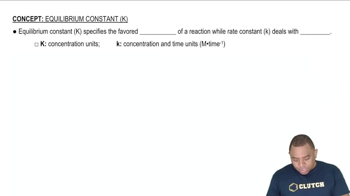
Equilibrium Constant (K)

The equilibrium constant (K) is a numerical value that expresses the ratio of the concentrations of products to reactants at equilibrium for a given chemical reaction at a specific temperature. It provides insight into the extent of the reaction; a large K indicates that products are favored, while a small K suggests that reactants are favored.
추천 영상:
가이드 코스
01:14
Equilibrium Constant K

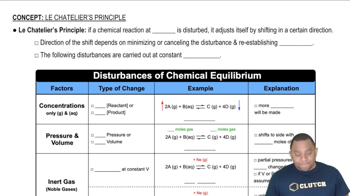
Le Chatelier's Principle

Le Chatelier's Principle states that if a system at equilibrium is subjected to a change in concentration, temperature, or pressure, the system will adjust to counteract that change and restore a new equilibrium. This principle helps predict how changes will affect the position of equilibrium and the value of the equilibrium constant.
추천 영상:
가이드 코스
07:32
Le Chatelier's Principle

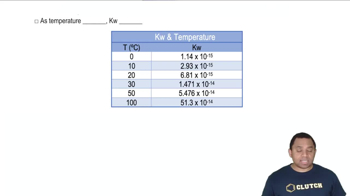
Temperature Dependence of K

The value of the equilibrium constant (K) is temperature-dependent, meaning it can change with variations in temperature. For exothermic reactions, increasing temperature typically decreases K, while for endothermic reactions, increasing temperature usually increases K. Understanding this relationship is crucial for calculating K at different temperatures.
추천 영상:
가이드 코스
01:24
Kw Temperature Dependence