
Ch.19 - Electrochemistry
McMurry - Chemistry 8th Edition
McMurry8th EditionChemistryISBN: 9781292336145당신이 사용하는 게 아니라요?교과서 변경
19장, 문제 161c

Experimental solid-oxide fuel cells that use butane (C4H10) as the fuel have been reported recently. These cells contain composite metal/metal oxide electrodes and a solid metal oxide electrolyte. The cell half-reactions are (c) How many grams of butane are required to produce a constant current of 10.5 A for 8.00 h? How many liters of gaseous butane at 20 °C and 815 mm Hg pressure are required?

검증된 단계별 안내
1
Identify the half-reaction involving butane (C_4H_{10}) and determine the number of electrons transferred per mole of butane.
Use the formula Q = I \(\times\) t to calculate the total charge (Q) in coulombs, where I is the current (10.5 A) and t is the time (8.00 h converted to seconds).
Use Faraday's constant (approximately 96485 C/mol) to convert the total charge to moles of electrons.
Relate the moles of electrons to moles of butane using the stoichiometry of the half-reaction.
Convert moles of butane to grams using the molar mass of butane (C_4H_{10}) and to liters using the ideal gas law, PV = nRT, with the given temperature and pressure.

비슷한 문제에 대한 검증된 영상 답변:

이 영상 해법은 위 문제에 도움이 된다고 튜터들이 추천한 것입니다.
영상 길이:
7m
도움이 되었나요?

주요 개념

질문에 올바르게 답하기 위해 반드시 이해해야 하는 핵심 개념들은 다음과 같습니다.

Electrochemical Reactions

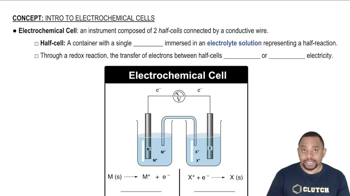
Electrochemical reactions involve the transfer of electrons between chemical species, which is fundamental in fuel cells. In a solid-oxide fuel cell, the oxidation of butane occurs at the anode, releasing electrons that flow through an external circuit, generating electric current. Understanding the half-reactions and the overall cell reaction is crucial for calculating the amount of fuel needed to sustain a specific current.
추천 영상:
가이드 코스
02:46
Electrochemical Cells

Current and Charge Relationship

The relationship between current (I), charge (Q), and time (t) is given by the equation Q = I × t. This concept is essential for determining how much charge is required to maintain a current of 10.5 A over 8 hours. By calculating the total charge, one can then relate it to the moles of butane consumed in the electrochemical reaction, allowing for the determination of the mass of butane needed.
추천 영상:

Ideal Gas Law

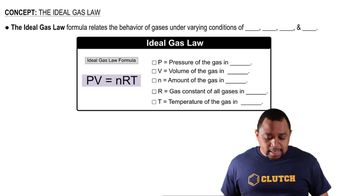
The Ideal Gas Law (PV = nRT) relates the pressure, volume, temperature, and number of moles of a gas. In this context, it is used to calculate the volume of gaseous butane required under specific conditions (20 °C and 815 mm Hg). Understanding how to manipulate this equation is vital for converting the amount of butane from grams to liters, ensuring accurate calculations for the fuel cell operation.
추천 영상:
가이드 코스
01:15
Ideal Gas Law Formula
관련 실천
교과서 질문

The half-reactions that occur in ordinary alkaline batteries can be written as In 1999, researchers in Israel reported a new type of alkaline battery, called a 'super-iron' battery. This battery uses the same anode reaction as an ordinary alkaline battery but involves the reduction of FeO42- ion (from K2FeO4) to solid Fe(OH)3 at the cathode. (a) Use the following standard reduction potential and any data from Appendixes C and D to calculate the standard cell potential expected for an ordinary alkaline battery:

798
views
교과서 질문

Experimental solid-oxide fuel cells that use butane (C4H10) as the fuel have been reported recently. These cells contain composite metal/metal oxide electrodes and a solid metal oxide electrolyte. The cell half-reactions are (b) Use the thermodynamic data in Appendix B to calculate the values of E° and the equilibrium constant K for the cell reaction at 25 °C. Will E° and K increase, decrease, or remain the same on raising the temperature?

300
views
교과서 질문

The half-reactions that occur in ordinary alkaline batteries can be written as In 1999, researchers in Israel reported a new type of alkaline battery, called a 'super-iron' battery. This battery uses the same anode reaction as an ordinary alkaline battery but involves the reduction of FeO42- ion (from K2FeO4) to solid Fe(OH)3 at the cathode. (b) Write a balanced equation for the cathode half-reaction in a super-iron battery. The half-reaction occurs in a basic environment.

486
views
교과서 질문
The nickel–iron battery has an iron anode, an NiO(OH) cathode, and a KOH electrolyte. This battery uses the follow-ing half-reactions and has an E° value of 1.37 V at 25 °C. (b) Calculate ∆G° (in kilojoules) and the equilibrium con-stant K for the cell reaction at 25 °C.
1005
views
교과서 질문

The half-reactions that occur in ordinary alkaline batteries can be written as In 1999, researchers in Israel reported a new type of alkaline battery, called a 'super-iron' battery. This battery uses the same anode reaction as an ordinary alkaline battery but involves the reduction of FeO42- ion (from K2FeO4) to solid Fe(OH)3 at the cathode. (c) A super-iron battery should last longer than an ordinary alkaline battery of the same size and weight because its cathode can provide more charge per unit mass. Quan-titatively compare the number of coulombs of charge released by the reduction of 10.0 g K2FeO4 to Fe(OH)3 with the number of coulombs of charge released by the reduction 10.0 g of MnO2 to MnO(OH).

311
views
교과서 질문
Consider a galvanic cell that utilizes the following half-reactions:

(b) What are the values of E° and the equilibrium constant K for the cell reaction at 25 °C?
651
views