
Ch.19 - Electrochemistry
McMurry - Chemistry 8th Edition
McMurry8th EditionChemistryISBN: 9781292336145당신이 사용하는 게 아니라요?교과서 변경
19장, 문제 160

The nickel–iron battery has an iron anode, an NiO(OH) cathode, and a KOH electrolyte. This battery uses the follow-ing half-reactions and has an E° value of 1.37 V at 25 °C. (b) Calculate ∆G° (in kilojoules) and the equilibrium con-stant K for the cell reaction at 25 °C.

검증된 단계별 안내
1
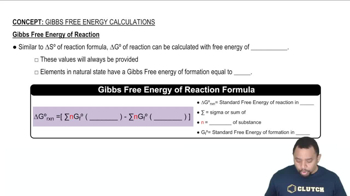
Identify the relationship between the standard cell potential (E°), the change in Gibbs free energy (∆G°), and the equilibrium constant (K). The relevant equations are: ∆G° = -nFE° and ∆G° = -RTlnK.
Determine the number of moles of electrons (n) transferred in the balanced overall cell reaction. This requires writing and balancing the half-reactions for the nickel–iron battery.
Use the equation ∆G° = -nFE° to calculate ∆G°, where F is the Faraday constant (approximately 96485 C/mol). Substitute the known values of n, F, and E° (1.37 V) into the equation.
Use the calculated ∆G° value in the equation ∆G° = -RTlnK to solve for the equilibrium constant K. Here, R is the universal gas constant (8.314 J/mol·K) and T is the temperature in Kelvin (25 °C = 298 K).
Rearrange the equation to solve for K: K = e^(-∆G°/RT). Substitute the values of ∆G°, R, and T to find the equilibrium constant K.

비슷한 문제에 대한 검증된 영상 답변:

이 영상 해법은 위 문제에 도움이 된다고 튜터들이 추천한 것입니다.
영상 길이:
3m
도움이 되었나요?

주요 개념

질문에 올바르게 답하기 위해 반드시 이해해야 하는 핵심 개념들은 다음과 같습니다.

Gibbs Free Energy (∆G°)

Gibbs Free Energy (∆G°) is a thermodynamic potential that measures the maximum reversible work obtainable from a thermodynamic system at constant temperature and pressure. It is calculated using the equation ∆G° = -nFE°, where n is the number of moles of electrons transferred, F is the Faraday constant, and E° is the standard cell potential. A negative ∆G° indicates a spontaneous reaction.
추천 영상:
가이드 코스
01:51
Gibbs Free Energy of Reactions

Standard Cell Potential (E°)

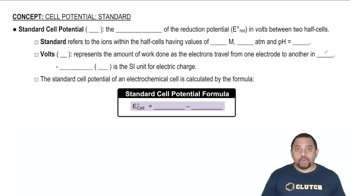
The standard cell potential (E°) is the measure of the voltage produced by an electrochemical cell under standard conditions (1 M concentration, 1 atm pressure, and 25 °C). It is determined by the difference in reduction potentials of the cathode and anode. A higher E° value indicates a greater tendency for the cell reaction to occur spontaneously.
추천 영상:
가이드 코스
01:27
Standard Cell Potential

Equilibrium Constant (K)

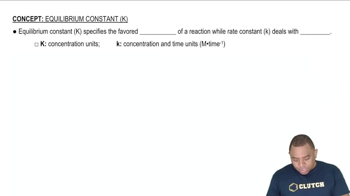
The equilibrium constant (K) is a dimensionless value that expresses the ratio of the concentrations of products to reactants at equilibrium for a given reaction. It can be related to Gibbs Free Energy by the equation ∆G° = -RT ln(K), where R is the universal gas constant and T is the temperature in Kelvin. A larger K value indicates a reaction that favors product formation at equilibrium.
추천 영상:
가이드 코스
01:14
Equilibrium Constant K
관련 실천
교과서 질문

The half-reactions that occur in ordinary alkaline batteries can be written as In 1999, researchers in Israel reported a new type of alkaline battery, called a 'super-iron' battery. This battery uses the same anode reaction as an ordinary alkaline battery but involves the reduction of FeO42- ion (from K2FeO4) to solid Fe(OH)3 at the cathode. (a) Use the following standard reduction potential and any data from Appendixes C and D to calculate the standard cell potential expected for an ordinary alkaline battery:

798
views
교과서 질문

Experimental solid-oxide fuel cells that use butane (C4H10) as the fuel have been reported recently. These cells contain composite metal/metal oxide electrodes and a solid metal oxide electrolyte. The cell half-reactions are (b) Use the thermodynamic data in Appendix B to calculate the values of E° and the equilibrium constant K for the cell reaction at 25 °C. Will E° and K increase, decrease, or remain the same on raising the temperature?

300
views
교과서 질문

Consider the redox titration (Section 4.13) of 120.0 mL of 0.100 M FeSO4 with 0.120 M K2Cr2O7 at 25 °C, assuming that the pH of the solution is maintained at 2.00 with a suitable buffer. The solution is in contact with a platinum electrode and constitutes one half-cell of an electrochemical cell. The other half-cell is a standard hydrogen electrode. The two half-cells are connected with a wire and a salt bridge, and the progress of the titration is monitored by measuring the cell potential with a voltmeter. (a) Write a balanced net ionic equation for the titration reaction, assuming that the products are Fe3+ and Cr3+.

370
views
교과서 질문
Consider a galvanic cell that utilizes the following half-reactions:

(b) What are the values of E° and the equilibrium constant K for the cell reaction at 25 °C?
651
views
교과서 질문

Experimental solid-oxide fuel cells that use butane (C4H10) as the fuel have been reported recently. These cells contain composite metal/metal oxide electrodes and a solid metal oxide electrolyte. The cell half-reactions are (c) How many grams of butane are required to produce a constant current of 10.5 A for 8.00 h? How many liters of gaseous butane at 20 °C and 815 mm Hg pressure are required?

507
views
교과서 질문
A concentration cell has the same half-reactions at the anode and cathode, but a voltage results from different concentrations in the two electrode compartments. (b) A similar cell has 0.10 M Cu2+ in both compartments. When a stoichiometric amount of ethylenediamine (NH2CH2CH2NH2) is added to one compartment, the measured cell potential is 0.179 V. Calculate the formation constant Kf for the complex ion Cu(NH2CH2CH2CH2)22+. Assume there is no volume change.
796
views