

Ch.19 - Electrochemistry
McMurry - Chemistry 8th Edition
McMurry8th EditionChemistryISBN: 9781292336145당신이 사용하는 게 아니라요?교과서 변경
19장, 문제 161b

Experimental solid-oxide fuel cells that use butane (C4H10) as the fuel have been reported recently. These cells contain composite metal/metal oxide electrodes and a solid metal oxide electrolyte. The cell half-reactions are (b) Use the thermodynamic data in Appendix B to calculate the values of E° and the equilibrium constant K for the cell reaction at 25 °C. Will E° and K increase, decrease, or remain the same on raising the temperature?

검증된 단계별 안내
1
Identify the half-reactions for the solid-oxide fuel cell using butane as the fuel. Typically, the oxidation of butane and the reduction of oxygen are involved.
Use the standard reduction potentials from Appendix B to calculate the standard cell potential, E°, by combining the half-reactions. Remember that E° = E°(cathode) - E°(anode).
Calculate the standard Gibbs free energy change, ΔG°, for the cell reaction using the formula ΔG° = -nFE°, where n is the number of moles of electrons transferred and F is the Faraday constant.
Determine the equilibrium constant, K, for the cell reaction using the relationship ΔG° = -RTlnK, where R is the universal gas constant and T is the temperature in Kelvin.
Discuss the effect of temperature on E° and K. According to the Nernst equation and the van 't Hoff equation, consider how changes in temperature might affect the cell potential and equilibrium constant.

비슷한 문제에 대한 검증된 영상 답변:

이 영상 해법은 위 문제에 도움이 된다고 튜터들이 추천한 것입니다.
영상 길이:
16m
도움이 되었나요?

주요 개념

질문에 올바르게 답하기 위해 반드시 이해해야 하는 핵심 개념들은 다음과 같습니다.

Electrochemical Cell Reactions

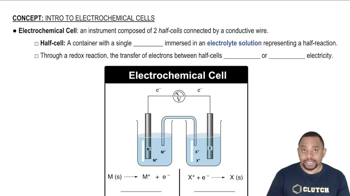
Electrochemical cells consist of two half-reactions: oxidation and reduction. In a solid-oxide fuel cell, the fuel (butane) undergoes oxidation at the anode, while a reduction reaction occurs at the cathode. Understanding these half-reactions is crucial for calculating the overall cell reaction and its thermodynamic properties.
추천 영상:
가이드 코스
02:46
Electrochemical Cells

Standard Electrode Potential (E°)

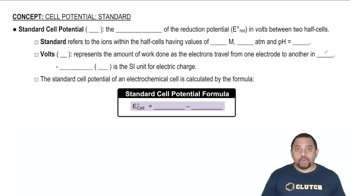
The standard electrode potential (E°) is a measure of the tendency of a chemical species to be reduced, expressed in volts. It is determined under standard conditions (1 M concentration, 1 atm pressure, and 25 °C). E° values are essential for predicting the direction of electron flow in electrochemical cells and calculating the cell's overall potential.
추천 영상:
가이드 코스
01:27
Standard Cell Potential

Equilibrium Constant (K) and Temperature Dependence

The equilibrium constant (K) quantifies the ratio of products to reactants at equilibrium for a given reaction. According to the van 't Hoff equation, K is temperature-dependent; as temperature increases, K can either increase or decrease depending on whether the reaction is exothermic or endothermic. This relationship is vital for understanding how changes in temperature affect the cell's performance.
추천 영상:
가이드 코스
01:14
Equilibrium Constant K
관련 실천
교과서 질문

The half-reactions that occur in ordinary alkaline batteries can be written as In 1999, researchers in Israel reported a new type of alkaline battery, called a 'super-iron' battery. This battery uses the same anode reaction as an ordinary alkaline battery but involves the reduction of FeO42- ion (from K2FeO4) to solid Fe(OH)3 at the cathode. (a) Use the following standard reduction potential and any data from Appendixes C and D to calculate the standard cell potential expected for an ordinary alkaline battery:

798
views
교과서 질문

The half-reactions that occur in ordinary alkaline batteries can be written as In 1999, researchers in Israel reported a new type of alkaline battery, called a 'super-iron' battery. This battery uses the same anode reaction as an ordinary alkaline battery but involves the reduction of FeO42- ion (from K2FeO4) to solid Fe(OH)3 at the cathode. (b) Write a balanced equation for the cathode half-reaction in a super-iron battery. The half-reaction occurs in a basic environment.

486
views
교과서 질문

Consider the redox titration (Section 4.13) of 120.0 mL of 0.100 M FeSO4 with 0.120 M K2Cr2O7 at 25 °C, assuming that the pH of the solution is maintained at 2.00 with a suitable buffer. The solution is in contact with a platinum electrode and constitutes one half-cell of an electrochemical cell. The other half-cell is a standard hydrogen electrode. The two half-cells are connected with a wire and a salt bridge, and the progress of the titration is monitored by measuring the cell potential with a voltmeter. (a) Write a balanced net ionic equation for the titration reaction, assuming that the products are Fe3+ and Cr3+.

370
views
교과서 질문
The nickel–iron battery has an iron anode, an NiO(OH) cathode, and a KOH electrolyte. This battery uses the follow-ing half-reactions and has an E° value of 1.37 V at 25 °C. (b) Calculate ∆G° (in kilojoules) and the equilibrium con-stant K for the cell reaction at 25 °C.
1005
views
교과서 질문
Consider a galvanic cell that utilizes the following half-reactions:

(b) What are the values of E° and the equilibrium constant K for the cell reaction at 25 °C?
651
views
교과서 질문

Experimental solid-oxide fuel cells that use butane (C4H10) as the fuel have been reported recently. These cells contain composite metal/metal oxide electrodes and a solid metal oxide electrolyte. The cell half-reactions are (c) How many grams of butane are required to produce a constant current of 10.5 A for 8.00 h? How many liters of gaseous butane at 20 °C and 815 mm Hg pressure are required?

507
views