Ch.2 - Atoms, Molecules & Ions
McMurry - Chemistry 8th Edition
McMurry8th EditionChemistryISBN: 9781292336145당신이 사용하는 게 아니라요?교과서 변경
2장, 문제 82

Benzene, ethane, and ethylene are just three of a large num-ber of hydrocarbons—compounds that contain only carbon and hydrogen. Show how the following data are consistent with the law of multiple proportions.

검증된 단계별 안내
1
Identify the chemical formulas for benzene, ethane, and ethylene: Benzene (C_6H_6), Ethane (C_2H_6), Ethylene (C_2H_4).
Calculate the ratio of carbon to hydrogen atoms in each compound: Benzene (6:6 or 1:1), Ethane (2:6 or 1:3), Ethylene (2:4 or 1:2).
Compare the ratios of carbon to hydrogen in these compounds to demonstrate the law of multiple proportions.
The law of multiple proportions states that if two elements form more than one compound, the ratios of the masses of the second element that combine with a fixed mass of the first element will be ratios of small whole numbers.
Show that the ratios of hydrogen to carbon in ethane and ethylene (3:2) and benzene and ethylene (1:2) are small whole numbers, consistent with the law of multiple proportions.

비슷한 문제에 대한 검증된 영상 답변:

이 영상 해법은 위 문제에 도움이 된다고 튜터들이 추천한 것입니다.
영상 길이:
8m

주요 개념

질문에 올바르게 답하기 위해 반드시 이해해야 하는 핵심 개념들은 다음과 같습니다.

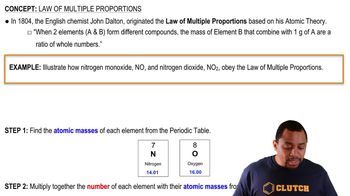
Law of Multiple Proportions

The Law of Multiple Proportions states that when two elements form more than one compound, the ratios of the masses of one element that combine with a fixed mass of the other element can be expressed as small whole numbers. This principle highlights the discrete nature of chemical combinations and is fundamental in understanding how different compounds can be formed from the same elements.
추천 영상:
가이드 코스
03:32
Law of Multiple Proportions

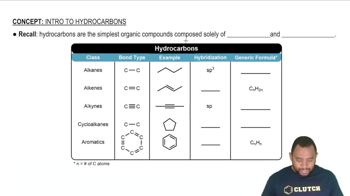
Hydrocarbons

Hydrocarbons are organic compounds consisting solely of carbon and hydrogen atoms. They can be classified into different categories, such as alkanes (saturated), alkenes (unsaturated with double bonds), and alkynes (unsaturated with triple bonds). Understanding the structure and types of hydrocarbons is essential for analyzing their chemical behavior and the relationships between different compounds.
추천 영상:
가이드 코스
04:29
Intro To Hydrocarbons

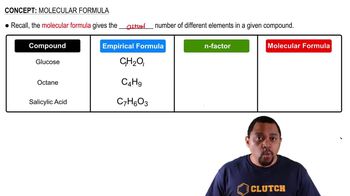
Molecular Formulas and Ratios

Molecular formulas represent the number and types of atoms in a molecule, providing insight into the composition of a compound. By comparing the molecular formulas of different hydrocarbons, one can determine the ratios of carbon to hydrogen atoms. These ratios are crucial for demonstrating the Law of Multiple Proportions, as they reveal how varying amounts of one element can combine with a fixed amount of another.
추천 영상:
가이드 코스
02:08
Determining Molecular Formulas
관련 실천
교과서 질문
The atomic weight of carbon (12.011) is approximately 12 times that of hydrogen (1.008). (a) Show how you can use this knowledge to calculate pos-sible formulas for benzene, ethane, and ethylene (Prob-lem 2.82).
1164
views
1
rank

교과서 질문
In methane, one part hydrogen combines with three parts carbon by mass. If a sample of a compound containing only carbon and hydrogen contains 32.0 g of carbon and 8.0 g of hydrogen, could the sample be methane? If the sample is not methane, show that the law of multiple proportions is fol-lowed for methane and this other substance.
517
views
교과서 질문
In borane, one part hydrogen combines with 3.6 parts boron by mass. A compound containing only hydrogen and boron contains 6.0 g of hydrogen and 43.2 g of boron. Could this compound be borane? If it is not borane, show that the law of multiple proportions is followed for borane and this other substance.
693
views
교과서 질문
A sample of CaCO3 was heated, causing it to form CaO and CO2 gas. Solid CaO remained behind, while the CO2 escaped to the atmosphere. If the CaCO3 weighed 612 g and the CaO weighed 343 g, how many grams of CO2 were formed in the reaction?
522
views
교과서 질문
Two compounds containing carbon and oxygen have the following percent composition by mass. Compound 1: 42.9% carbon and 57.1% oxygen Compound 2: 27.3% carbon and 72.7% oxygen Show that the law of multiple proportions is followed. If the formula of the first compound is CO, what is the formula of the second compound?
1370
views
1
rank