Two compounds containing carbon and oxygen have the following percent composition by mass. Compound 1: 42.9% carbon and 57.1% oxygen Compound 2: 27.3% carbon and 72.7% oxygen Show that the law of multiple proportions is followed. If the formula of the first compound is CO, what is the formula of the second compound?
검증된 단계별 안내
1
Identify the mass of carbon and oxygen in 100 g of each compound. For Compound 1, you have 42.9 g of carbon and 57.1 g of oxygen. For Compound 2, you have 27.3 g of carbon and 72.7 g of oxygen.
Convert the masses of carbon and oxygen to moles using their molar masses (C: 12.01 g/mol, O: 16.00 g/mol). Calculate the moles of carbon and oxygen in each compound.
Determine the simplest whole number ratio of moles of carbon to moles of oxygen for each compound. For Compound 1, this should match the given formula CO.
For Compound 2, use the mole ratio to determine the empirical formula. Divide the moles of each element by the smallest number of moles to find the simplest ratio.
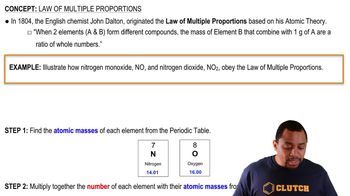
Compare the ratios of the two compounds to demonstrate the law of multiple proportions, which states that the ratios of the masses of the second element that combine with a fixed mass of the first element are simple whole numbers.
비슷한 문제에 대한 검증된 영상 답변:
이 영상 해법은 위 문제에 도움이 된다고 튜터들이 추천한 것입니다.
영상 길이:
2m
영상 재생:
0 댓글
도움이 되었나요?
주요 개념
질문에 올바르게 답하기 위해 반드시 이해해야 하는 핵심 개념들은 다음과 같습니다.
Law of Multiple Proportions
The Law of Multiple Proportions states that when two elements form more than one compound, the ratios of the masses of one element that combine with a fixed mass of the other element can be expressed as small whole numbers. This principle helps to demonstrate that compounds can have different compositions while still being made of the same elements.
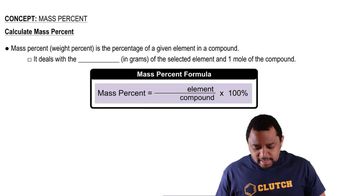
Percent composition refers to the percentage by mass of each element in a compound. It is calculated by dividing the mass of the element in one mole of the compound by the molar mass of the compound, then multiplying by 100. Understanding percent composition is crucial for comparing different compounds and determining their formulas.
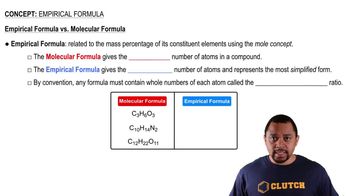
The empirical formula represents the simplest whole-number ratio of the elements in a compound, while the molecular formula shows the actual number of atoms of each element in a molecule. In this question, knowing the empirical formula of the first compound (CO) allows us to deduce the molecular formula of the second compound based on its percent composition.