Ch.20 - Nuclear Chemistry
McMurry - Chemistry 8th Edition
McMurry8th EditionChemistryISBN: 9781292336145당신이 사용하는 게 아니라요?교과서 변경
20장, 문제 88

Identify the false statement about nuclear fission. (a) Nuclear fission is induced by bombarding a U-235 sample with beta particles. (b) Nuclear fission is the splitting of a heavy element into lighter elements. (c) Mass is converted to energy in nuclear fission. (d) Nuclear fission releases huge amounts of energy compared to chemical reactions. (e) Nuclear fission can cause a chain reaction because additional neutrons are produced with each fission of a nucleus.

검증된 단계별 안내
1
Step 1: Understand the process of nuclear fission. Nuclear fission is a nuclear reaction in which a heavy nucleus splits into two or more smaller nuclei, along with the release of energy and additional neutrons.
Step 2: Analyze statement (a). Nuclear fission is typically induced by bombarding a U-235 nucleus with neutrons, not beta particles. Beta particles are high-energy, high-speed electrons or positrons emitted by certain types of radioactive nuclei, which are not used to induce fission.
Step 3: Evaluate statement (b). This statement is true as nuclear fission involves the splitting of a heavy element into lighter elements.
Step 4: Consider statement (c). This statement is true because, according to Einstein's equation E=mc^2, mass is converted into energy during nuclear fission.
Step 5: Review statements (d) and (e). Both are true: (d) nuclear fission releases a large amount of energy compared to chemical reactions, and (e) the process can lead to a chain reaction due to the production of additional neutrons.

주요 개념

질문에 올바르게 답하기 위해 반드시 이해해야 하는 핵심 개념들은 다음과 같습니다.

Nuclear Fission

Nuclear fission is a process in which a heavy atomic nucleus, such as uranium-235, splits into two or more lighter nuclei, along with the release of energy and neutrons. This reaction can occur spontaneously or be induced by bombarding the nucleus with particles, typically neutrons, rather than beta particles.
추천 영상:
가이드 코스
03:29
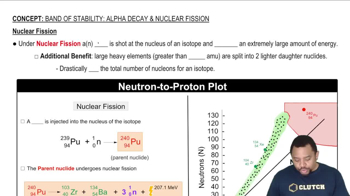
Band of Stability: Nuclear Fission

Energy Conversion

In nuclear fission, a small amount of the mass of the original nucleus is converted into a large amount of energy, as described by Einstein's equation E=mc². This energy release is significantly greater than that from chemical reactions, making nuclear fission a powerful energy source.
추천 영상:
가이드 코스
01:56
Conversion Factors

Chain Reaction

A chain reaction in nuclear fission occurs when the neutrons released from one fission event induce further fission events in nearby nuclei. This self-sustaining process can lead to a rapid release of energy, which is the principle behind both nuclear reactors and atomic bombs.
추천 영상:
가이드 코스
01:30
Alcohol Reactions: Dehydration Reactions