Ch.21 - Transition Elements and Coordination Chemistry
McMurry - Chemistry 8th Edition
McMurry8th EditionChemistryISBN: 9781292336145당신이 사용하는 게 아니라요?교과서 변경
21장, 문제 36

Use the periodic table to provide the electron configuration for each of the following atoms and ions: (a) Co (b) Co2+

검증된 단계별 안내
1
Step 1: Identify the atomic number of cobalt (Co) from the periodic table. Cobalt has an atomic number of 27, which means it has 27 electrons in its neutral state.
Step 2: Write the electron configuration for a neutral cobalt atom. Start by filling the electron orbitals in order of increasing energy: 1s, 2s, 2p, 3s, 3p, 4s, 3d. Use the Aufbau principle, Hund's rule, and the Pauli exclusion principle to guide the filling of orbitals.
Step 3: For Co, the electron configuration is: 1s22s22p63s23p64s23d7. This configuration accounts for all 27 electrons.
Step 4: To find the electron configuration for the Co2+ ion, remove two electrons from the neutral cobalt atom. Electrons are typically removed from the highest energy level first, which in this case is the 4s orbital.
Step 5: The electron configuration for Co2+ is: 1s22s22p63s23p63d7. Notice that the 4s electrons are removed, leaving the 3d electrons unchanged.

주요 개념

질문에 올바르게 답하기 위해 반드시 이해해야 하는 핵심 개념들은 다음과 같습니다.

Electron Configuration

Electron configuration describes the distribution of electrons in an atom's orbitals. It follows the Aufbau principle, which states that electrons fill the lowest energy orbitals first, and is typically represented using the notation of subshells (s, p, d, f) and their respective electron counts. Understanding electron configuration is essential for predicting an element's chemical behavior and reactivity.
추천 영상:
가이드 코스
01:33
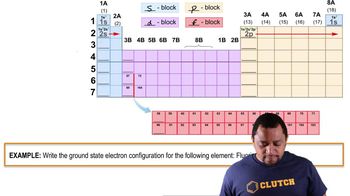
Electron Configuration Example

Periodic Table

The periodic table organizes elements based on their atomic number, electron configurations, and recurring chemical properties. Elements in the same group often exhibit similar behaviors due to their similar valence electron configurations. Familiarity with the periodic table allows for quick identification of an element's position, which aids in determining its electron configuration.
추천 영상:
가이드 코스
02:40
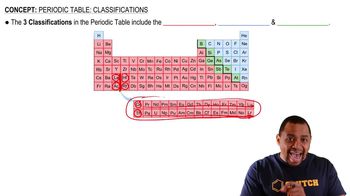
Periodic Table Classifications

Ionic Charge and Electron Loss

Ionic charge refers to the net electrical charge an atom or ion carries due to the loss or gain of electrons. For example, cobalt (Co) can lose two electrons to form Co2+, resulting in a different electron configuration than its neutral state. Understanding how to adjust the electron configuration based on ionic charge is crucial for accurately representing ions.
추천 영상: