Molybdenum (mp 2623 °C) has a higher melting point than yttrium (mp 1522 °C) or cadmium (mp 321 °C). Explain.
Ch.21 - Transition Elements and Coordination Chemistry
21장, 문제 36c,d
Use the periodic table to give the electron configuration for each of the following atoms and ions.
(c) Co(V) in CoO43–
(d) Co(IV) in CoF62–
검증된 단계별 안내1
Step 1: Determine the atomic number of cobalt (Co) from the periodic table, which is 27. This means a neutral cobalt atom has 27 electrons.
Step 2: Write the electron configuration for a neutral cobalt atom (Co). The electron configuration is: 1s^2 2s^2 2p^6 3s^2 3p^6 4s^2 3d^7.
Step 3: For Co(V) in CoO4^3-, determine the oxidation state. Co(V) means cobalt is in the +5 oxidation state. Subtract 5 electrons from the neutral cobalt electron configuration.
Step 4: For Co(IV) in CoF6^2-, determine the oxidation state. Co(IV) means cobalt is in the +4 oxidation state. Subtract 4 electrons from the neutral cobalt electron configuration.
Step 5: Adjust the electron configurations for Co(V) and Co(IV) by removing electrons starting from the outermost shell (4s) and then from the 3d subshell.

비슷한 문제에 대한 검증된 영상 답변:
이 영상 해법은 위 문제에 도움이 된다고 튜터들이 추천한 것입니다.
주요 개념
질문에 올바르게 답하기 위해 반드시 이해해야 하는 핵심 개념들은 다음과 같습니다.
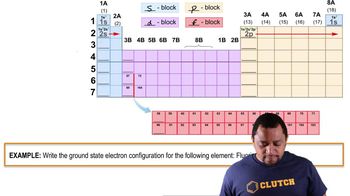
Electron Configuration
Electron configuration describes the distribution of electrons in an atom's orbitals. It follows the Aufbau principle, which states that electrons fill lower-energy orbitals first, and is represented using a notation that indicates the energy levels and sublevels occupied by electrons. Understanding electron configuration is essential for predicting an element's chemical behavior and bonding characteristics.
추천 영상:
가이드 코스
Electron Configuration Example
Oxidation States
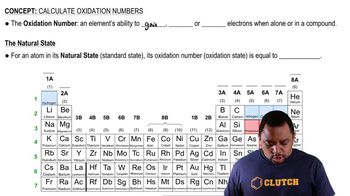
Oxidation states indicate the degree of oxidation of an atom in a compound, reflecting the number of electrons lost, gained, or shared during chemical bonding. For transition metals like cobalt, oxidation states can vary, and they are crucial for determining the electron configuration of ions. Knowing the oxidation state helps in correctly assigning the number of electrons to be considered in the electron configuration.
추천 영상:
가이드 코스
Oxidation Numbers
Ionic Compounds and Charge
Ionic compounds are formed when atoms transfer electrons, resulting in the formation of positively and negatively charged ions. The charge of the ions influences their electron configurations, as it determines how many electrons are lost or gained. For example, Co(V) indicates cobalt in a +5 oxidation state, while Co(IV) indicates a +4 state, which directly affects the electron configuration of these ions.
추천 영상:
가이드 코스
Ionic Compounds Naming
관련 실천
교과서 질문
115
views
교과서 질문
Briefly account for each of the following observations:
(a) Atomic radii decrease in the order Sc > Ti > V.
(b) Densities increase in the order Ti > V > Cr.
124
views
교과서 질문
Titanium, used to make jet aircraft engines, is much harder than potassium or calcium. Explain.
93
views
교과서 질문
Consider the following ethylenediamine complexes.
(a) Which complexes are chiral, and which are achiral?
(b) Draw the enantiomer of each chiral complex.
(c) Which, if any, of the chiral complexes are enantiomers of one another?
115
views
교과서 질문
Consider the following ethylenediamine complexes.
(a) Which complexes are chiral, and which are achiral?
(b) Draw the enantiomer of each chiral complex.
(c) Which, if any, of the chiral complexes are enantiomers of one another?
92
views