Ch.21 - Transition Elements and Coordination Chemistry
McMurry - Chemistry 8th Edition
McMurry8th EditionChemistryISBN: 9781292336145당신이 사용하는 게 아니라요?교과서 변경
21장, 문제 21.80a

What is the systematic name for each of the following coordination compounds? 
(a) Cs[FeCl4]
(b) [V(H2O)6](NO3)3

검증된 단계별 안내
1
Identify the central metal ion and its oxidation state in each coordination compound.
For compound (a) Cs[FeCl_4], determine the oxidation state of iron (Fe) by considering the charge of the chloride ligands and the cesium cation.
Name the anionic complex in compound (a) by using the suffix '-ate' for the metal and specifying the oxidation state of the metal in Roman numerals.
For compound (b) [V(H_2O)_6](NO_3)_3, identify the central metal ion and its oxidation state by considering the charge of the water ligands and the nitrate anions.
Name the cationic complex in compound (b) by specifying the metal, its oxidation state in Roman numerals, and the ligands in alphabetical order.

비슷한 문제에 대한 검증된 영상 답변:

이 영상 해법은 위 문제에 도움이 된다고 튜터들이 추천한 것입니다.

주요 개념

질문에 올바르게 답하기 위해 반드시 이해해야 하는 핵심 개념들은 다음과 같습니다.

Coordination Compounds

Coordination compounds consist of a central metal atom or ion bonded to surrounding molecules or ions, known as ligands. The nature of these bonds and the arrangement of ligands around the metal center are crucial for determining the compound's properties and reactivity. Understanding the structure and nomenclature of these compounds is essential for systematic naming.
추천 영상:
가이드 코스
01:32
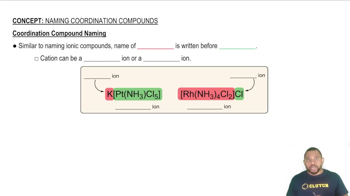
Coordination Compound Naming

Nomenclature of Coordination Compounds

The nomenclature of coordination compounds follows specific rules set by the International Union of Pure and Applied Chemistry (IUPAC). This includes naming the ligands first, followed by the metal, and indicating the oxidation state of the metal in Roman numerals. The order and format of these names are critical for accurately conveying the identity of the compound.
추천 영상:
가이드 코스
01:32
Coordination Compound Naming

Oxidation States

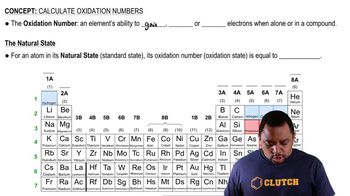
The oxidation state of a metal in a coordination compound indicates its charge and is vital for understanding the compound's stability and reactivity. It is determined by the total charge of the complex and the charges contributed by the ligands. Correctly identifying and representing oxidation states is essential for systematic naming and understanding the compound's behavior.
추천 영상:
가이드 코스
02:42
Oxidation Numbers
관련 실천
교과서 질문

What is the name of the compound [Fe(H2O)5(SCN)]Cl2? 

(a) pentaaquathiocyanatoiron(III) chloride 

(b) pentaaquachlorothiocyanato iron(III) 

(c) pentaaquathiocyanatoiron(III) dichloride

(d) pentaaquathiocyanatoiron(II) chloride

494
views

교과서 질문

Two first-series transition metals have three unpaired electrons in complex ions of the type [MCl4]2-.

(a) What are the oxidation state and the identity of M in these complexes?

(b) Draw valence bond orbital diagrams for the two possible ions.

(c) Based on common oxidation states of first-series transition metals (Figure 21.6), which ion is more likely to exist?

<QUESTION REFERENCES FIGURE 21.6>

77
views
교과서 질문

Constitutional isomers of a ruthenium(II) coordination compound are shown below.

(a) Give the formula and name for structures 1-3.

(b) Which structures are linkage isomers? 

(c) Which structures are ionization isomers?

93
views
교과서 질문

Nickel(II) complexes with the formula NiX2L2, where X− is Cl− or N-bonded NCS− and L is the monodentate triphenylphosphine ligand P(C6H5)3, can be square planar or tetrahedral.

(a) Draw crystal field energy-level diagrams for a square planar and a tetrahedral nickel(II) complex, and show the population of the orbitals.

98
views
교과서 질문

There are two possible [M(OH)4]- complexes of first-series transition metals that have three unpaired electrons.

(a) What are the oxidation state and the identity of M in these complexes?

(b) Using orbital diagrams, give a valence bond description of the bonding in each complex.

(c) Based on common oxidation states of first-series transition metals (Figure 21.6), which [M(OH)4]- complex is more likely to exist? 

<QUESTION REFERENCES FIGURE 21.6>-

106
views
교과서 질문

Classify the following ligands as monodentate, bidentate, tri-dentate, or tetradentate. Which can form chelate rings?

(a)  

(b) 

(c) 

(d) 

108
views