Ch.21 - Transition Elements and Coordination Chemistry
McMurry - Chemistry 8th Edition
McMurry8th EditionChemistryISBN: 9781292336145당신이 사용하는 게 아니라요?교과서 변경
21장, 문제 21.128a

There are two possible [M(OH)4]- complexes of first-series transition metals that have three unpaired electrons.
(a) What are the oxidation state and the identity of M in these complexes?
(b) Using orbital diagrams, give a valence bond description of the bonding in each complex.
(c) Based on common oxidation states of first-series transition metals (Figure 21.6), which [M(OH)4]- complex is more likely to exist? 
<QUESTION REFERENCES FIGURE 21.6>-

검증된 단계별 안내
1
Identify the first-series transition metals that can form [M(OH)_4]^- complexes with three unpaired electrons. Consider the electronic configuration of these metals in their common oxidation states.
Determine the oxidation state of M in the [M(OH)_4]^- complex. Since the hydroxide ion (OH^-) has a charge of -1, and the overall charge of the complex is -1, calculate the oxidation state of M.
For each identified metal, draw the orbital diagram for the valence electrons in the oxidation state determined. Show how the electrons are distributed among the d orbitals, ensuring there are three unpaired electrons.
Use valence bond theory to describe the bonding in each complex. Consider the hybridization of the metal's orbitals and how they overlap with the orbitals of the hydroxide ligands.
Refer to Figure 21.6 to compare the common oxidation states of the identified metals. Determine which metal is more likely to exist in the [M(OH)_4]^- complex based on its stability and prevalence in that oxidation state.

비슷한 문제에 대한 검증된 영상 답변:

이 영상 해법은 위 문제에 도움이 된다고 튜터들이 추천한 것입니다.
도움이 되었나요?

주요 개념

질문에 올바르게 답하기 위해 반드시 이해해야 하는 핵심 개념들은 다음과 같습니다.

Oxidation States of Transition Metals

The oxidation state of a transition metal indicates the charge it would have if all ligands were removed, and all bonding electrons were assigned to the more electronegative atom. Transition metals can exhibit multiple oxidation states due to their ability to lose different numbers of d-electrons. Understanding the common oxidation states helps in predicting the identity of the metal in complexes and their stability.
추천 영상:
가이드 코스
03:12
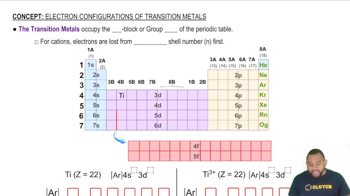
Transition Metals

Valence Bond Theory and Orbital Diagrams

Valence Bond Theory explains how atomic orbitals combine to form bonds in molecules. Orbital diagrams visually represent the distribution of electrons in these orbitals, showing how unpaired electrons can participate in bonding. For transition metal complexes, the arrangement of d-orbitals and their interactions with ligands are crucial for understanding the geometry and bonding characteristics of the complex.
추천 영상:
가이드 코스
04:12
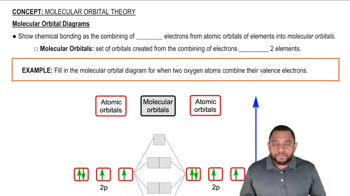
Molecular Orbital Diagram

Ligand Field Theory

Ligand Field Theory extends the concepts of Valence Bond Theory by considering the effect of ligands on the energy levels of d-orbitals in transition metals. It explains how the presence of ligands can split the d-orbital energies, influencing the number of unpaired electrons and the overall stability of the complex. This theory is essential for predicting the likelihood of certain oxidation states and the formation of specific metal-ligand complexes.
추천 영상:
가이드 코스
02:40
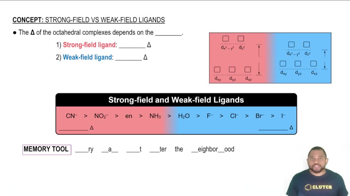
Strong-Field Ligands result in a large Δ and Weak-Field Ligands result in a small Δ.