Ch.21 - Transition Elements and Coordination Chemistry
McMurry - Chemistry 8th Edition
McMurry8th EditionChemistryISBN: 9781292336145당신이 사용하는 게 아니라요?교과서 변경
21장, 문제 21.30

Classify the following ligands as monodentate, bidentate, tri-dentate, or tetradentate. Which can form chelate rings?
(a)  
(b) 
(c) 
(d) 

검증된 단계별 안내
1
1. To classify ligands, we need to know their structures and how many sites they can use to bind to a central metal ion. Monodentate ligands have one site, bidentate ligands have two, tridentate ligands have three, and tetradentate ligands have four.
2. A ligand can form a chelate ring if it is at least bidentate, meaning it has two or more sites to bind to the central metal ion. This allows it to 'wrap around' the metal ion and form a ring structure.
3. Unfortunately, without the specific ligands provided in the problem, we cannot classify them or determine if they can form chelate rings. Please provide the specific ligands for further assistance.
4. Once the ligands are provided, you can identify the number of potential binding sites by looking for atoms with lone pairs of electrons. These are typically oxygen, nitrogen, or sulfur atoms in the ligand.
5. To determine if a ligand can form a chelate ring, look for multiple binding sites that are close enough together on the ligand to both bind to the same metal ion. If this is possible, the ligand can form a chelate ring.

비슷한 문제에 대한 검증된 영상 답변:

이 영상 해법은 위 문제에 도움이 된다고 튜터들이 추천한 것입니다.
도움이 되었나요?

주요 개념

질문에 올바르게 답하기 위해 반드시 이해해야 하는 핵심 개념들은 다음과 같습니다.

Ligand Denticity

Denticity refers to the number of donor atoms in a ligand that can bind to a central metal atom in a coordination complex. Monodentate ligands have one donor atom, bidentate ligands have two, tridentate have three, and tetradentate have four. Understanding denticity is crucial for classifying ligands and predicting their behavior in coordination chemistry.
추천 영상:
가이드 코스
01:12
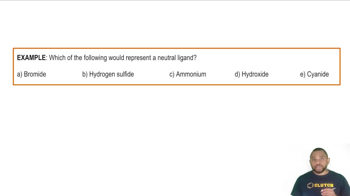
Ligands Example

Chelation

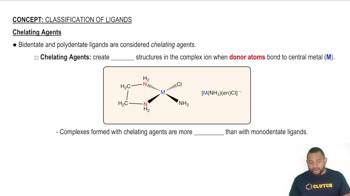
Chelation is the process by which a multidentate ligand binds to a metal ion, forming a stable ring structure known as a chelate. This occurs when the ligand wraps around the metal ion, creating a more stable complex than with monodentate ligands. Recognizing which ligands can form chelate rings is essential for understanding their stability and reactivity in various chemical environments.
추천 영상:
가이드 코스
01:21
Chelating Agents

Coordination Complexes

Coordination complexes consist of a central metal atom bonded to surrounding ligands. The nature of these ligands, including their denticity, influences the geometry, stability, and reactivity of the complex. Familiarity with coordination chemistry is necessary to classify ligands and predict the formation of chelate rings in these complexes.
추천 영상:
가이드 코스
00:43
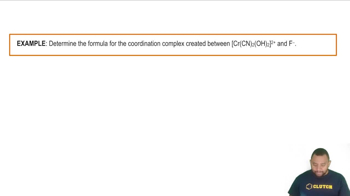
Coordination Complexes Example