
Ch.3 - Mass Relationships in Chemical Reactions
McMurry - Chemistry 8th Edition
McMurry8th EditionChemistryISBN: 9781292336145당신이 사용하는 게 아니라요?교과서 변경
3장, 문제 124a

(a) Polychlorinated biphenyls (PCBs) were compounds used as coolants in transformers and capacitors, but their production was banned by the U.S. Congress in 1979 because they are highly toxic and persist in the environment. When 1.0 g of a PCB containing carbon, hydrogen, and chlorine was subjected to combustion analysis, 1.617 g of CO2. and 0.138 g of H2O were produced. What is the empirical formula?

검증된 단계별 안내
1
Determine the moles of carbon in the CO_2 produced. Use the molar mass of CO_2 (44.01 g/mol) to find the moles of CO_2, then use the ratio of carbon in CO_2 to find the moles of carbon.
Determine the moles of hydrogen in the H_2O produced. Use the molar mass of H_2O (18.02 g/mol) to find the moles of H_2O, then use the ratio of hydrogen in H_2O to find the moles of hydrogen.
Calculate the mass of carbon and hydrogen in the original PCB sample using their respective moles and atomic masses (C: 12.01 g/mol, H: 1.008 g/mol).
Subtract the mass of carbon and hydrogen from the total mass of the PCB sample to find the mass of chlorine.
Convert the mass of chlorine to moles using the atomic mass of chlorine (Cl: 35.45 g/mol), then determine the simplest whole number ratio of moles of C, H, and Cl to find the empirical formula.

비슷한 문제에 대한 검증된 영상 답변:

이 영상 해법은 위 문제에 도움이 된다고 튜터들이 추천한 것입니다.
영상 길이:
4m
도움이 되었나요?

주요 개념

질문에 올바르게 답하기 위해 반드시 이해해야 하는 핵심 개념들은 다음과 같습니다.

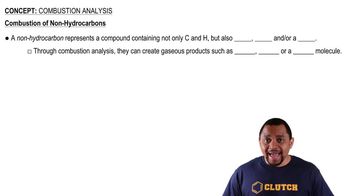
Combustion Analysis

Combustion analysis is a technique used to determine the composition of organic compounds by burning them in excess oxygen. The products of combustion, typically carbon dioxide (CO2) and water (H2O), are measured to calculate the amounts of carbon and hydrogen in the original sample. This method is essential for finding the empirical formula of a compound, as it provides the necessary data on the elemental composition.
추천 영상:
가이드 코스
01:29
Combustion of Non-Hydrocarbons

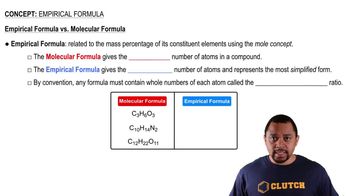
Empirical Formula

The empirical formula of a compound represents the simplest whole-number ratio of the elements present in that compound. It is derived from the amounts of each element obtained from combustion analysis. For example, if a compound contains carbon, hydrogen, and chlorine, the empirical formula will reflect the ratio of these elements based on their respective moles calculated from the combustion products.
추천 영상:
가이드 코스
02:26
Empirical vs Molecular Formula

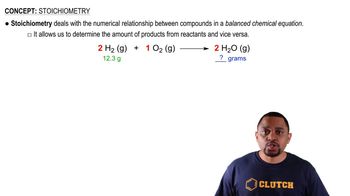
Stoichiometry

Stoichiometry is the branch of chemistry that deals with the quantitative relationships between the reactants and products in a chemical reaction. It allows chemists to calculate the amounts of substances consumed and produced in a reaction based on balanced chemical equations. In the context of combustion analysis, stoichiometry is used to convert the masses of CO2 and H2O produced into moles of carbon and hydrogen, which are then used to determine the empirical formula.
추천 영상:
가이드 코스
01:16
Stoichiometry Concept