
Ch.3 - Mass Relationships in Chemical Reactions
McMurry - Chemistry 8th Edition
McMurry8th EditionChemistryISBN: 9781292336145당신이 사용하는 게 아니라요?교과서 변경
3장, 문제 124c

(c) Can combustion analysis be used to determine the empirical formula of a compound containing carbon, hydrogen, oxygen, and chlorine?

검증된 단계별 안내
1
Step 1: Understand the concept of combustion analysis. Combustion analysis is a method used to determine the elemental composition of a substance. In this process, a sample is burned in excess oxygen to produce carbon dioxide, water, and other products.
Step 2: Identify the elements that can be determined by combustion analysis. Combustion analysis can directly determine the amount of carbon and hydrogen in a compound because these elements are converted to carbon dioxide and water, respectively, which can be collected and measured.
Step 3: Consider the elements that cannot be directly determined by combustion analysis. Oxygen and chlorine are not directly determined by this method because they do not form unique gases that can be easily collected and measured. However, their presence can be inferred indirectly.
Step 4: Calculate the amount of oxygen and chlorine. After determining the amounts of carbon and hydrogen, the remainder of the sample's mass is attributed to the other elements present, in this case, oxygen and chlorine.
Step 5: Determine the empirical formula. Once the amounts of carbon, hydrogen, oxygen, and chlorine are known, these can be converted to moles and the empirical formula can be determined by finding the simplest whole number ratio of these elements.

비슷한 문제에 대한 검증된 영상 답변:

이 영상 해법은 위 문제에 도움이 된다고 튜터들이 추천한 것입니다.
영상 길이:
1m

주요 개념

질문에 올바르게 답하기 위해 반드시 이해해야 하는 핵심 개념들은 다음과 같습니다.

Combustion Analysis

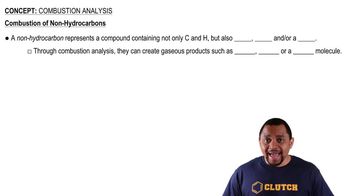
Combustion analysis is a technique used to determine the elemental composition of organic compounds. In this method, a sample is burned in excess oxygen, converting its elements into gaseous products, primarily CO2 and H2O. By measuring the amounts of these products, one can calculate the moles of carbon and hydrogen in the original compound, which is essential for determining its empirical formula.
추천 영상:
가이드 코스
01:29
Combustion of Non-Hydrocarbons

Empirical Formula

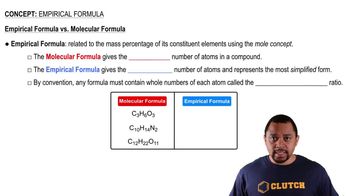
The empirical formula of a compound represents the simplest whole-number ratio of the elements present in that compound. It is derived from the mole ratios obtained from combustion analysis or other methods. For compounds containing multiple elements, such as carbon, hydrogen, oxygen, and chlorine, the empirical formula provides a foundational understanding of the compound's composition, even if it does not reflect the actual molecular structure.
추천 영상:
가이드 코스
02:26
Empirical vs Molecular Formula

Elemental Analysis of Chlorine

In combustion analysis, while carbon, hydrogen, and oxygen can be quantified through the measurement of CO2 and H2O, chlorine presents a challenge. Chlorine does not form stable gaseous products during combustion; instead, it typically forms HCl. Therefore, additional analytical techniques, such as titration or ion chromatography, are often required to accurately determine the chlorine content in the compound, which is crucial for calculating the complete empirical formula.
추천 영상:
가이드 코스
06:11
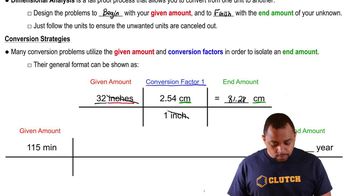
Dimensional Analysis
관련 실천
교과서 질문
When solid mercury(I) carbonate, Hg2CO3, is added to nitric acid, HNO3, a reaction occurs to give mercury(II) nitrate, Hg1NO322, water, and two gases A and B: Hg2CO31s2 + HNO31aq2¡ Hg1NO3221aq2 + H2O1l 2 + A1g2 + B1g2 (e) Write a balanced equation for the reaction of mercury(I) carbonate with nitric acid.
1263
views
교과서 질문
Correct the error in each of the following statements: (a) The formula of ammonia is NH3 (b) Molecules of potassium chloride have the formula KCl. (c) Cl-is a cation. (d) CH4 is a polyatomic ion
556
views
교과서 질문

(b) If the molecular weight is 326.26, what is the molecular formula?

429
views
교과서 질문
Ethylene glycol, commonly used as automobile antifreeze, contains only carbon, hydrogen, and oxygen. Combustion analysis of a 23.46 mg sample yields 20.42 mg of H2O and 33.27 mg of CO2. What is the empirical formula of ethylene glycol? What is its molecular formula if it has a molecular weight of 62.0?
1266
views
1
rank
교과서 질문

(a) Polychlorinated biphenyls (PCBs) were compounds used as coolants in transformers and capacitors, but their production was banned by the U.S. Congress in 1979 because they are highly toxic and persist in the environment. When 1.0 g of a PCB containing carbon, hydrogen, and chlorine was subjected to combustion analysis, 1.617 g of CO2. and 0.138 g of H2O were produced. What is the empirical formula?

701
views
교과서 질문
The symbol CO stands for carbon monoxide, but the sym-bol Co stands for the element cobalt. Explain.
2636
views