
Ch.3 - Mass Relationships in Chemical Reactions
McMurry - Chemistry 8th Edition
McMurry8th EditionChemistryISBN: 9781292336145당신이 사용하는 게 아니라요?교과서 변경
3장, 문제 124b

(b) If the molecular weight is 326.26, what is the molecular formula?

검증된 단계별 안내
1
Step 1: The first step in determining the molecular formula is to calculate the empirical formula weight. This is done by adding up the atomic weights of all the atoms in the empirical formula.
Step 2: Once you have the empirical formula weight, divide the molecular weight by the empirical formula weight. This will give you a ratio, which should be a whole number or very close to a whole number.
Step 3: If the ratio is not a whole number, round it to the nearest whole number. This is because the molecular formula must contain whole numbers of atoms.
Step 4: Multiply each subscript in the empirical formula by the ratio you calculated in step 2. This will give you the molecular formula.
Step 5: Check your work by calculating the molecular weight of the molecular formula you determined. It should match the given molecular weight.

비슷한 문제에 대한 검증된 영상 답변:

이 영상 해법은 위 문제에 도움이 된다고 튜터들이 추천한 것입니다.
영상 길이:
8m
도움이 되었나요?

주요 개념

질문에 올바르게 답하기 위해 반드시 이해해야 하는 핵심 개념들은 다음과 같습니다.

Molecular Weight

Molecular weight, or molar mass, is the mass of one mole of a substance, typically expressed in grams per mole (g/mol). It is calculated by summing the atomic weights of all atoms in a molecule, which can be found on the periodic table. Understanding molecular weight is crucial for determining the composition and stoichiometry of chemical compounds.
추천 영상:
가이드 코스
03:45
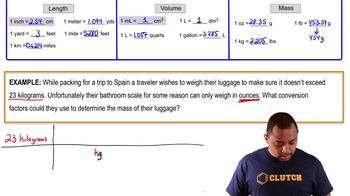
Weight Conversion Example

Empirical Formula

The empirical formula represents the simplest whole-number ratio of the elements in a compound. It provides insight into the relative proportions of each element but does not convey the actual number of atoms in a molecule. To derive the molecular formula from the empirical formula, one must know the molecular weight of the compound.
추천 영상:
가이드 코스
02:26
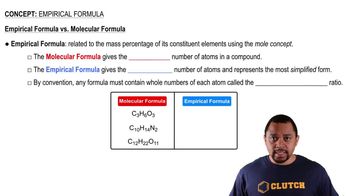
Empirical vs Molecular Formula

Molecular Formula

The molecular formula indicates the actual number of each type of atom in a molecule of a compound. It is derived from the empirical formula by multiplying the subscripts by a whole number, which is determined by dividing the molecular weight by the empirical formula weight. This formula is essential for understanding the structure and reactivity of the compound.
추천 영상:
가이드 코스
02:08
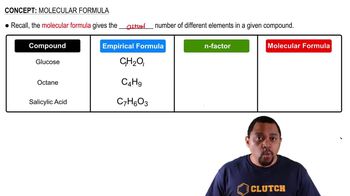
Determining Molecular Formulas
관련 실천
교과서 질문
An unidentified metal M reacts with an unidentified halogen X to form a compound MX2. When heated, the compound decomposes by the reaction: When 1.12 g of MX2 is heated, 0.720 g of MX is obtained, along with 56.0 mL of X2 gas. Under the conditions used, 1.00 mol of the gas has a volume of 22.41 L. (a) What is the atomic weight and identity of the halogen X?
517
views
교과서 질문

(c) Can combustion analysis be used to determine the empirical formula of a compound containing carbon, hydrogen, oxygen, and chlorine?

721
views
1
rank
교과서 질문
Correct the error in each of the following statements: (a) The formula of ammonia is NH3 (b) Molecules of potassium chloride have the formula KCl. (c) Cl-is a cation. (d) CH4 is a polyatomic ion
556
views
교과서 질문
Ethylene glycol, commonly used as automobile antifreeze, contains only carbon, hydrogen, and oxygen. Combustion analysis of a 23.46 mg sample yields 20.42 mg of H2O and 33.27 mg of CO2. What is the empirical formula of ethylene glycol? What is its molecular formula if it has a molecular weight of 62.0?
1265
views
1
rank
교과서 질문

(a) Polychlorinated biphenyls (PCBs) were compounds used as coolants in transformers and capacitors, but their production was banned by the U.S. Congress in 1979 because they are highly toxic and persist in the environment. When 1.0 g of a PCB containing carbon, hydrogen, and chlorine was subjected to combustion analysis, 1.617 g of CO2. and 0.138 g of H2O were produced. What is the empirical formula?

701
views
교과서 질문
The symbol CO stands for carbon monoxide, but the sym-bol Co stands for the element cobalt. Explain.
2636
views