Ch.6 - Ionic Compounds: Periodic Trends and Bonding Theory
McMurry - Chemistry 8th Edition
McMurry8th EditionChemistryISBN: 9781292336145당신이 사용하는 게 아니라요?교과서 변경
6장, 문제 120

Order the following atoms according to increasing atomic radius: S, F, O.

검증된 단계별 안내
1
Identify the periodic trend for atomic radius: Atomic radius generally increases as you move down a group and decreases as you move across a period from left to right.
Locate the elements on the periodic table: Sulfur (S), Fluorine (F), and Oxygen (O) are all in the same period (Period 2).
Compare the positions of the elements: In Period 2, the order from left to right is O, F, S.
Apply the periodic trend: Since atomic radius decreases from left to right across a period, the order of increasing atomic radius is F, O, S.
Conclude the order: Therefore, the order of increasing atomic radius is F < O < S.

비슷한 문제에 대한 검증된 영상 답변:

이 영상 해법은 위 문제에 도움이 된다고 튜터들이 추천한 것입니다.
영상 길이:
3m

주요 개념

질문에 올바르게 답하기 위해 반드시 이해해야 하는 핵심 개념들은 다음과 같습니다.

Atomic Radius

Atomic radius is a measure of the size of an atom, typically defined as the distance from the nucleus to the outermost electron shell. It can vary based on the atom's position in the periodic table, influenced by factors such as nuclear charge and electron shielding. Generally, atomic radius increases down a group and decreases across a period.
추천 영상:

Periodic Trends

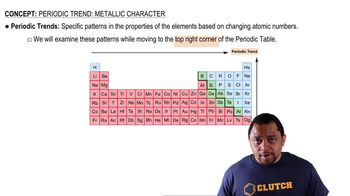
Periodic trends refer to the predictable patterns observed in the properties of elements as you move across or down the periodic table. For atomic radius, as you move from left to right across a period, the radius decreases due to increased nuclear charge attracting electrons more strongly. Conversely, as you move down a group, the radius increases due to the addition of electron shells.
추천 영상:
가이드 코스
00:38
Periodic Trends

Electronegativity

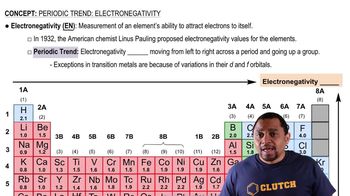
Electronegativity is the tendency of an atom to attract electrons in a chemical bond. It is closely related to atomic radius; smaller atoms with higher electronegativity tend to have a stronger pull on electrons. In the context of the question, understanding electronegativity helps explain why fluorine, being the most electronegative and smallest atom among S, F, and O, has the smallest atomic radius.
추천 영상:
가이드 코스
02:10
Electronegativity Trends
관련 실천
교과서 질문
Take a guess. What do you think is a likely ground-state electron configuration for the sodium ion, Na+, formed by loss of an electron from a neutral sodium atom?
601
views

교과서 질문
The ionization energy of an atom can be measured by photo-electron spectroscopy, in which light of wavelength l is directed at an atom, causing an electron to be ejected. The kinetic energy of the ejected electron 1EK2 is measured by determining its velocity, v since EK = 1/2 mv2. The Ei is then calculated using the relationship that the energy of the inci-dent light equals the sum of Ei plus EK. (a) What is the ionization energy of rubidium atoms in kilo-joules per mole if light with l = 58.4 nm produces elec-trons with a velocity of 2.450 * 106m/s? (The mass of an electron is 9.109 * 10-31 kg.)
2585
views
1
rank
1
comments
교과서 질문
One method for calculating Zeff is to use the equation

where E is the energy necessary to remove an electron from an atom and n is the principal quantum number of the elec-tron. Use this equation to calculate Zeff values for the highest-energy electrons in potassium (E = 418.8 kJ/mol) and krypton (E = 1350.7 kJ/mol).
1040
views
교과서 질문

Iron is commonly found as Fe, Fe2++, and Fe3+. (c) The third ionization energy of Fe is Ei3 = +2952 kJ/mol. What is the longest wavelength of light that could ionize Fe2+(g) to Fe3+(g)?

1646
views
교과서 질문
Which atom in each of the following pairs has a larger radius? (a) Na or K (b) V or Ta (c) V or Zn (d) Li or Ba
630
views
교과서 질문
Which atom in each of the following pairs has a larger radius? (a) C or Ge (b) Ni or Pt (c) Sn or I (d) Na or Rb
937
views
1
comments