Ch.6 - Ionic Compounds: Periodic Trends and Bonding Theory
McMurry - Chemistry 8th Edition
McMurry8th EditionChemistryISBN: 9781292336145당신이 사용하는 게 아니라요?교과서 변경
6장, 문제 105

The ionization energy of an atom can be measured by photo-electron spectroscopy, in which light of wavelength l is directed at an atom, causing an electron to be ejected. The kinetic energy of the ejected electron 1EK2 is measured by determining its velocity, v since EK = 1/2 mv2. The Ei is then calculated using the relationship that the energy of the inci-dent light equals the sum of Ei plus EK. (a) What is the ionization energy of rubidium atoms in kilo-joules per mole if light with l = 58.4 nm produces elec-trons with a velocity of 2.450 * 106m/s? (The mass of an electron is 9.109 * 10-31 kg.)

검증된 단계별 안내
1
Calculate the energy of the incident light (E) using the formula E = hc/\(\lambda\), where h is Planck's constant (6.626 x 10^-34 J s), c is the speed of light (3.00 x 10^8 m/s), and \(\lambda\) is the wavelength of the light (58.4 nm converted to meters).
Calculate the kinetic energy (EK) of the ejected electron using the formula EK = 1/2 mv^2, where m is the mass of an electron (9.109 x 10^-31 kg) and v is the velocity of the electron (2.450 x 10^6 m/s).
Use the relationship that the energy of the incident light equals the sum of the ionization energy (Ei) and the kinetic energy of the ejected electron (EK) to set up the equation: E = Ei + EK.
Solve the equation from step 3 for the ionization energy (Ei) by rearranging it to Ei = E - EK.
Convert the ionization energy (Ei) from joules to kilo-joules per mole by multiplying by Avogadro's number (6.022 x 10^23 mol^-1) and dividing by 1000 to convert joules to kilo-joules.

비슷한 문제에 대한 검증된 영상 답변:

이 영상 해법은 위 문제에 도움이 된다고 튜터들이 추천한 것입니다.
영상 길이:
5m

주요 개념

질문에 올바르게 답하기 위해 반드시 이해해야 하는 핵심 개념들은 다음과 같습니다.

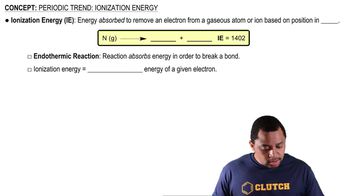
Ionization Energy

Ionization energy is the amount of energy required to remove an electron from an atom in its gaseous state. It is a crucial property that reflects the strength of the attraction between the nucleus and the electrons. Higher ionization energy indicates a stronger hold on the electrons, while lower ionization energy suggests that electrons can be removed more easily.
추천 영상:
가이드 코스
01:19
Ionization Energy

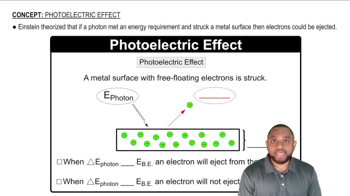
Photoelectron Spectroscopy

Photoelectron spectroscopy is an experimental technique used to study the energy levels of electrons in atoms. In this method, photons of light are directed at an atom, causing the ejection of electrons. By measuring the kinetic energy of these ejected electrons, one can infer the ionization energy and gain insights into the electronic structure of the atom.
추천 영상:
가이드 코스
02:31
Photoelectric Effect

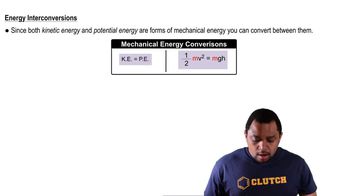
Kinetic Energy of Electrons

The kinetic energy (KE) of an ejected electron is calculated using the formula KE = 1/2 mv², where m is the mass of the electron and v is its velocity. This relationship is essential for determining how much energy the electron possesses after being ejected, which is then used to calculate the ionization energy by considering the energy of the incident light.
추천 영상:
가이드 코스
00:34
Kinetic & Potential Energy