Which atom in each of the following pairs has a larger radius?
(a) Na or K
(b) V or Ta
(c) V or Zn
(d) Li or Ba
검증된 단계별 안내
1
Step 1: Understand that atomic radius generally increases as you move down a group in the periodic table because additional electron shells are added.
Step 2: For part (a), compare Na (sodium) and K (potassium). Both are in Group 1, but K is below Na, so K has a larger atomic radius.
Step 3: For part (b), compare V (vanadium) and Ta (tantalum). Both are in Group 5, but Ta is below V, so Ta has a larger atomic radius.
Step 4: For part (c), compare V (vanadium) and Zn (zinc). Both are in the same period, but V is to the left of Zn, so V has a larger atomic radius due to less effective nuclear charge.
Step 5: For part (d), compare Li (lithium) and Ba (barium). Both are in Group 2, but Ba is below Li, so Ba has a larger atomic radius.
비슷한 문제에 대한 검증된 영상 답변:
이 영상 해법은 위 문제에 도움이 된다고 튜터들이 추천한 것입니다.
영상 길이:
2m
영상 재생:
0 댓글
주요 개념
질문에 올바르게 답하기 위해 반드시 이해해야 하는 핵심 개념들은 다음과 같습니다.
Atomic Radius
Atomic radius is defined as the distance from the nucleus of an atom to the outermost shell of electrons. It is a key factor in determining the size of an atom and varies across the periodic table. Generally, atomic radius increases down a group due to the addition of electron shells, while it decreases across a period from left to right due to increased nuclear charge attracting electrons more strongly.
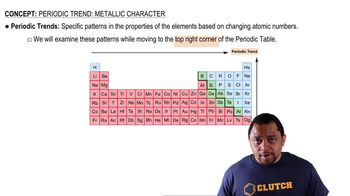
Periodic trends refer to the predictable patterns observed in the properties of elements as you move across or down the periodic table. For atomic radius, the trend shows that elements in the same group have larger radii as you move down, while elements in the same period have smaller radii as you move from left to right. Understanding these trends is essential for comparing the sizes of different atoms.
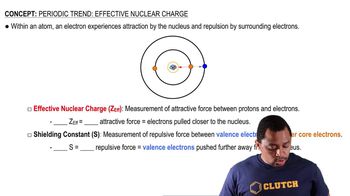
Effective nuclear charge (Z_eff) is the net positive charge experienced by an electron in a multi-electron atom. It accounts for the shielding effect of inner electrons that reduces the full nuclear charge felt by outer electrons. A higher effective nuclear charge leads to a smaller atomic radius, as the increased attraction pulls the outer electrons closer to the nucleus, which is crucial for understanding the size differences in the given pairs.


 검증된 단계별 안내

 02:02
02:02