Ch.6 - Ionic Compounds: Periodic Trends and Bonding Theory
McMurry - Chemistry 8th Edition
McMurry8th EditionChemistryISBN: 9781292336145당신이 사용하는 게 아니라요?교과서 변경
6장, 문제 73

Why does phosphorus have a less negative electron affinity than its neighbors silicon and sulfur?

검증된 단계별 안내
1
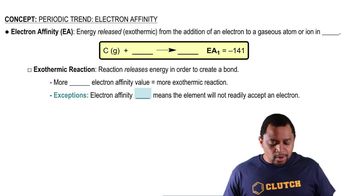
Step 1: Understand the concept of electron affinity, which is the energy change that occurs when an electron is added to a neutral atom in the gas phase, forming a negative ion.
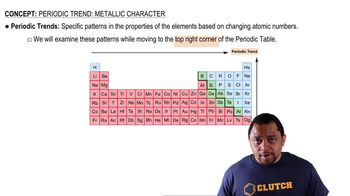
Step 2: Recognize that electron affinity generally becomes more negative across a period from left to right due to increasing nuclear charge, which attracts additional electrons more strongly.
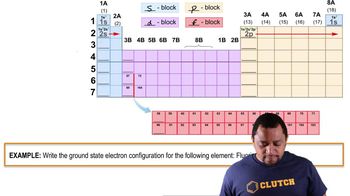
Step 3: Consider the electronic configuration of phosphorus, which is [Ne] 3s² 3p³. Adding an electron to phosphorus results in a half-filled p subshell becoming more stable, but not as stable as a completely filled or empty subshell.
Step 4: Compare phosphorus with its neighbors: Silicon ([Ne] 3s² 3p²) and Sulfur ([Ne] 3s² 3p⁴). Silicon gains stability by achieving a half-filled p subshell, while sulfur gains stability by achieving a completely filled p subshell.
Step 5: Conclude that phosphorus has a less negative electron affinity than silicon and sulfur because adding an electron to phosphorus does not result in as stable a configuration as it does for its neighbors, due to the stability associated with half-filled and completely filled subshells.

주요 개념

질문에 올바르게 답하기 위해 반드시 이해해야 하는 핵심 개념들은 다음과 같습니다.

Electron Affinity

Electron affinity is the energy change that occurs when an electron is added to a neutral atom in the gas phase. A more negative electron affinity indicates a greater tendency for an atom to gain an electron, releasing energy in the process. Understanding this concept is crucial for comparing the electron affinities of different elements, as it reflects their reactivity and stability when forming anions.
추천 영상:
가이드 코스
01:34
Electron Affinity

Atomic Structure and Electron Configuration

The atomic structure of an element, including its electron configuration, influences its chemical properties, including electron affinity. Phosphorus has a half-filled p subshell, which provides some stability, while silicon and sulfur have different configurations that affect their ability to accommodate additional electrons. This structural difference is key to understanding why phosphorus has a less negative electron affinity compared to its neighbors.
추천 영상:
가이드 코스
01:33
Electron Configuration Example

Trends in the Periodic Table

Periodic trends, such as electron affinity, can be understood by examining the position of elements in the periodic table. Generally, electron affinity becomes more negative across a period from left to right due to increasing nuclear charge, which attracts electrons more strongly. However, exceptions exist, such as phosphorus, where its unique electron configuration leads to a less negative value compared to silicon and sulfur, highlighting the complexity of periodic trends.
추천 영상:
가이드 코스
00:38
Periodic Trends