Ch.7 - Covalent Bonding and Electron-Dot Structures
McMurry - Chemistry 8th Edition
McMurry8th EditionChemistryISBN: 9781292336145당신이 사용하는 게 아니라요?교과서 변경
7장, 문제 40

Match the following descriptions with the type of bond (ionic, nonpolar covalent, covalent). (a) One or more electrons are transferred from a metal to a nonmetal atom.

검증된 단계별 안내
1
Identify the key characteristics of the bond described in the problem.
Recognize that the transfer of electrons typically occurs between a metal and a nonmetal.
Recall that when electrons are transferred, the resulting bond is usually ionic.
Understand that ionic bonds form between atoms with significantly different electronegativities.
Match the description 'One or more electrons are transferred from a metal to a nonmetal atom' with the type of bond: ionic.

비슷한 문제에 대한 검증된 영상 답변:

이 영상 해법은 위 문제에 도움이 된다고 튜터들이 추천한 것입니다.
영상 길이:
1m
도움이 되었나요?

주요 개념

질문에 올바르게 답하기 위해 반드시 이해해야 하는 핵심 개념들은 다음과 같습니다.

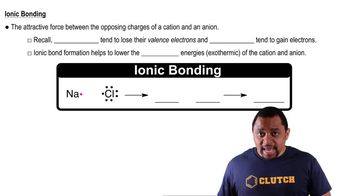
Ionic Bonding

Ionic bonding occurs when one atom donates one or more electrons to another atom, resulting in the formation of charged ions. Typically, this involves a metal atom losing electrons to become a positively charged cation, while a nonmetal atom gains those electrons to become a negatively charged anion. The electrostatic attraction between these oppositely charged ions creates a strong bond, characteristic of ionic compounds.
추천 영상:

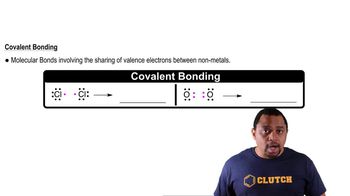
Covalent Bonding

Covalent bonding involves the sharing of electron pairs between atoms, usually between nonmetals. In this type of bond, atoms achieve stability by sharing electrons, which allows them to fill their outer electron shells. Covalent bonds can be single, double, or triple, depending on the number of shared electron pairs, and they can vary in polarity based on the electronegativity of the bonded atoms.
추천 영상:

Nonpolar Covalent Bonding

Nonpolar covalent bonding occurs when two identical nonmetal atoms share electrons equally, resulting in no charge separation. This type of bond typically forms between atoms with similar electronegativities, such as in diatomic molecules like O2 or N2. Because the electron distribution is symmetrical, nonpolar covalent bonds do not create dipoles, making these molecules generally nonpolar in nature.
추천 영상:
관련 실천