Ch.7 - Covalent Bonding and Electron-Dot Structures
McMurry - Chemistry 8th Edition
McMurry8th EditionChemistryISBN: 9781292336145당신이 사용하는 게 아니라요?교과서 변경
7장, 문제 46

What general trends in electronegativity occur in the periodic table?

검증된 단계별 안내
1
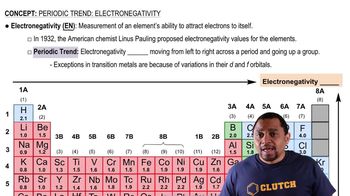
Electronegativity is the tendency of an atom to attract electrons towards itself in a chemical bond.
In the periodic table, electronegativity generally increases across a period from left to right. This is because the number of protons in the nucleus increases, which enhances the nucleus's ability to attract electrons.
Electronegativity generally decreases down a group. As you move down a group, the atomic radius increases due to the addition of electron shells, which reduces the nucleus's pull on the valence electrons.
The most electronegative element is fluorine, located at the top right of the periodic table, excluding the noble gases.
Noble gases are typically not assigned electronegativity values because they usually do not form bonds with other elements due to their full valence electron shells.

비슷한 문제에 대한 검증된 영상 답변:

이 영상 해법은 위 문제에 도움이 된다고 튜터들이 추천한 것입니다.
영상 길이:
1m
도움이 되었나요?

주요 개념

질문에 올바르게 답하기 위해 반드시 이해해야 하는 핵심 개념들은 다음과 같습니다.

Electronegativity

Electronegativity is a measure of an atom's ability to attract and hold onto electrons when it forms a chemical bond. It is a key factor in determining the nature of bonds between atoms, influencing whether they are ionic or covalent. The most commonly used scale for electronegativity is the Pauling scale, where fluorine is the most electronegative element.
추천 영상:
가이드 코스
02:10
Electronegativity Trends

Periodic Trends

Periodic trends refer to the predictable patterns observed in the properties of elements as you move across or down the periodic table. Key trends include electronegativity, atomic radius, ionization energy, and electron affinity. Understanding these trends helps in predicting how elements will react chemically and their bonding behavior.
추천 영상:
가이드 코스
00:38
Periodic Trends

Trends in Electronegativity

In the periodic table, electronegativity generally increases from left to right across a period and decreases from top to bottom within a group. This is due to the increasing nuclear charge attracting electrons more strongly across a period, while the addition of electron shells down a group increases distance and shielding, reducing the nucleus's pull on bonding electrons.
추천 영상:
가이드 코스
02:10
Electronegativity Trends