Explain the difference in the bond dissociation energies for the following bonds: (C-F, 450 kJ/mol), (N-F, 270 kJ/mol), (O-F, 180 kJ/mol), (F-F, 159 kJ/mol).
검증된 단계별 안내
1
Identify the bond dissociation energy (BDE) for each bond: C-F (450 kJ/mol), N-F (270 kJ/mol), O-F (180 kJ/mol), F-F (159 kJ/mol).
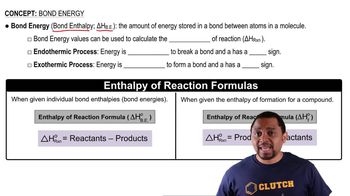
Understand that bond dissociation energy is the energy required to break a bond in a molecule, indicating bond strength.
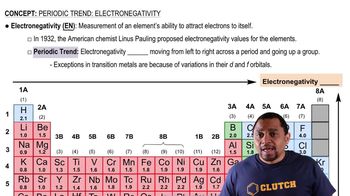
Consider the electronegativity of the atoms involved: Fluorine is highly electronegative, affecting bond strength with different atoms.
Analyze the bond length: Shorter bonds are generally stronger, contributing to higher BDE.
Compare the atomic sizes and electronegativity differences: Larger differences in electronegativity and smaller atomic sizes typically result in stronger bonds, explaining the trend in BDE values.
비슷한 문제에 대한 검증된 영상 답변:
이 영상 해법은 위 문제에 도움이 된다고 튜터들이 추천한 것입니다.
영상 길이:
2m
영상 재생:
0 댓글
도움이 되었나요?
주요 개념
질문에 올바르게 답하기 위해 반드시 이해해야 하는 핵심 개념들은 다음과 같습니다.
Bond Dissociation Energy
Bond dissociation energy (BDE) is the energy required to break a bond in a molecule, resulting in the formation of separate atoms. It is a measure of bond strength; higher BDE values indicate stronger bonds. BDE can vary significantly between different types of bonds due to factors such as atomic size, electronegativity, and the presence of lone pairs.
Electronegativity is the tendency of an atom to attract electrons in a chemical bond. In the context of the bonds mentioned, fluorine is highly electronegative, which affects the bond strength with other elements. The differences in electronegativity between the bonded atoms can lead to variations in bond character (ionic vs. covalent) and, consequently, the bond dissociation energies.
Atomic size influences bond length, which in turn affects bond strength. Smaller atoms can form shorter, stronger bonds due to effective overlap of their atomic orbitals. In the case of the bonds listed, the size of the atoms involved (C, N, O, and F) contributes to the observed differences in bond dissociation energies, as shorter bonds generally have higher BDEs.