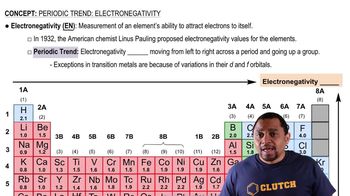
Which of the following substances contain bonds that are largely ionic?
(a) HF
(b) HI
(c) PdCl2
(d) BBr3
(e) NaOH
(f) CH3Li
검증된 단계별 안내
1
insert step 1> Identify the nature of the bond in each compound by considering the elements involved and their positions in the periodic table.
insert step 2> Recall that ionic bonds typically form between metals and nonmetals, where there is a significant difference in electronegativity.
insert step 3> For each compound, determine the type of elements present: metals, nonmetals, or metalloids.
insert step 4> Compare the electronegativity of the elements in each compound to assess whether the bond is likely to be ionic (large difference) or covalent (small difference).
insert step 5> Identify the compounds with the largest electronegativity differences, indicating largely ionic bonds.
비슷한 문제에 대한 검증된 영상 답변:
이 영상 해법은 위 문제에 도움이 된다고 튜터들이 추천한 것입니다.
영상 길이:
3m
영상 재생:
0 댓글
주요 개념
질문에 올바르게 답하기 위해 반드시 이해해야 하는 핵심 개념들은 다음과 같습니다.
Ionic Bonds
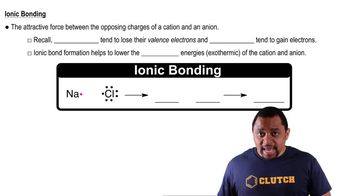
Ionic bonds are formed when electrons are transferred from one atom to another, resulting in the formation of charged ions. Typically, this occurs between metals, which lose electrons and become positively charged, and nonmetals, which gain electrons and become negatively charged. The electrostatic attraction between these oppositely charged ions creates a strong bond, characteristic of ionic compounds.
Electronegativity is a measure of an atom's ability to attract and hold onto electrons in a chemical bond. The greater the difference in electronegativity between two bonded atoms, the more ionic the bond is considered to be. For example, a large difference indicates that one atom is likely to completely transfer an electron to the other, leading to the formation of ions.
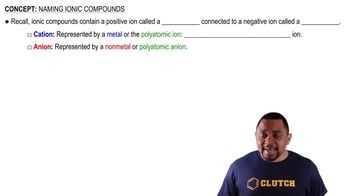
Ionic compounds typically consist of a metal and a nonmetal, while covalent compounds are formed between nonmetals. Ionic compounds tend to have high melting and boiling points due to the strong attractions between ions, whereas covalent compounds usually have lower melting points. Understanding the nature of the bonding in a substance helps in predicting its properties and behavior in chemical reactions.


 검증된 단계별 안내
 01:49
01:49