Ch.7 - Covalent Bonding and Electron-Dot Structures
McMurry - Chemistry 8th Edition
McMurry8th EditionChemistryISBN: 9781292336145당신이 사용하는 게 아니라요?교과서 변경
7장, 문제 47

Predict the electronegativity of the undiscovered element with Z = 119.

검증된 단계별 안내
1
Step 1: Understand that electronegativity is a measure of the tendency of an atom to attract a bonding pair of electrons. The Pauling scale is the most commonly used electronegativity scale, and it ranges from 0.7 (for Francium) to 4.0 (for Fluorine).
Step 2: Recognize that the element with atomic number Z = 119 would be the first element in the 8th period of the periodic table, following the trend of the periodic table where elements are added in increasing atomic number.
Step 3: Note that electronegativity generally increases across a period (from left to right) and decreases down a group (from top to bottom) on the periodic table. This is due to the increase in effective nuclear charge across a period and the increase in atomic radius down a group.
Step 4: Given that the element with Z = 119 would be the first element in a new period, it would likely have a relatively low electronegativity, similar to the alkali metals (Group 1 elements) in the previous periods.
Step 5: However, keep in mind that predicting the properties of undiscovered elements is not an exact science and the actual electronegativity of the element with Z = 119 could be different due to factors not accounted for in these general trends.

비슷한 문제에 대한 검증된 영상 답변:

이 영상 해법은 위 문제에 도움이 된다고 튜터들이 추천한 것입니다.
영상 길이:
1m
도움이 되었나요?

주요 개념

질문에 올바르게 답하기 위해 반드시 이해해야 하는 핵심 개념들은 다음과 같습니다.

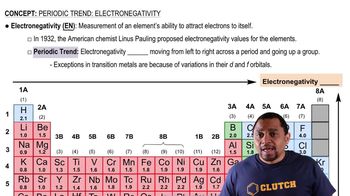
Electronegativity

Electronegativity is a measure of an atom's ability to attract and hold onto electrons when it forms chemical bonds. It is a key factor in determining the nature of bonds between atoms, influencing whether they will form ionic or covalent bonds. The Pauling scale is commonly used to quantify electronegativity values, with higher values indicating a stronger attraction for electrons.
추천 영상:
가이드 코스
02:10
Electronegativity Trends

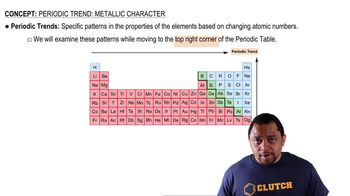
Periodic Trends

Periodic trends refer to the predictable patterns observed in the properties of elements as you move across or down the periodic table. Electronegativity generally increases across a period from left to right and decreases down a group. Understanding these trends helps in predicting the behavior of elements, including the electronegativity of undiscovered elements based on their position in the periodic table.
추천 영상:
가이드 코스
00:38
Periodic Trends

Element Z = 119

Element Z = 119 refers to the hypothetical element that would be located in the seventh period of the periodic table, following element 118 (Oganesson). As a superheavy element, it is expected to exhibit unique properties due to relativistic effects, which can influence its electronegativity. Predictions about its electronegativity must consider both its position in the periodic table and the behavior of similar elements.
추천 영상:
가이드 코스
02:35
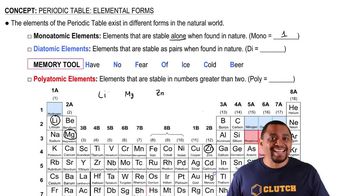
Elemental Forms of Elements