(b) When xenon absorbs 801 kJ/mol of energy, it is excited into a higher-energy state in which the outermost elec-tron has been promoted to the next available subshell. Write the electron configuration for this excited xenon.
검증된 단계별 안내
1
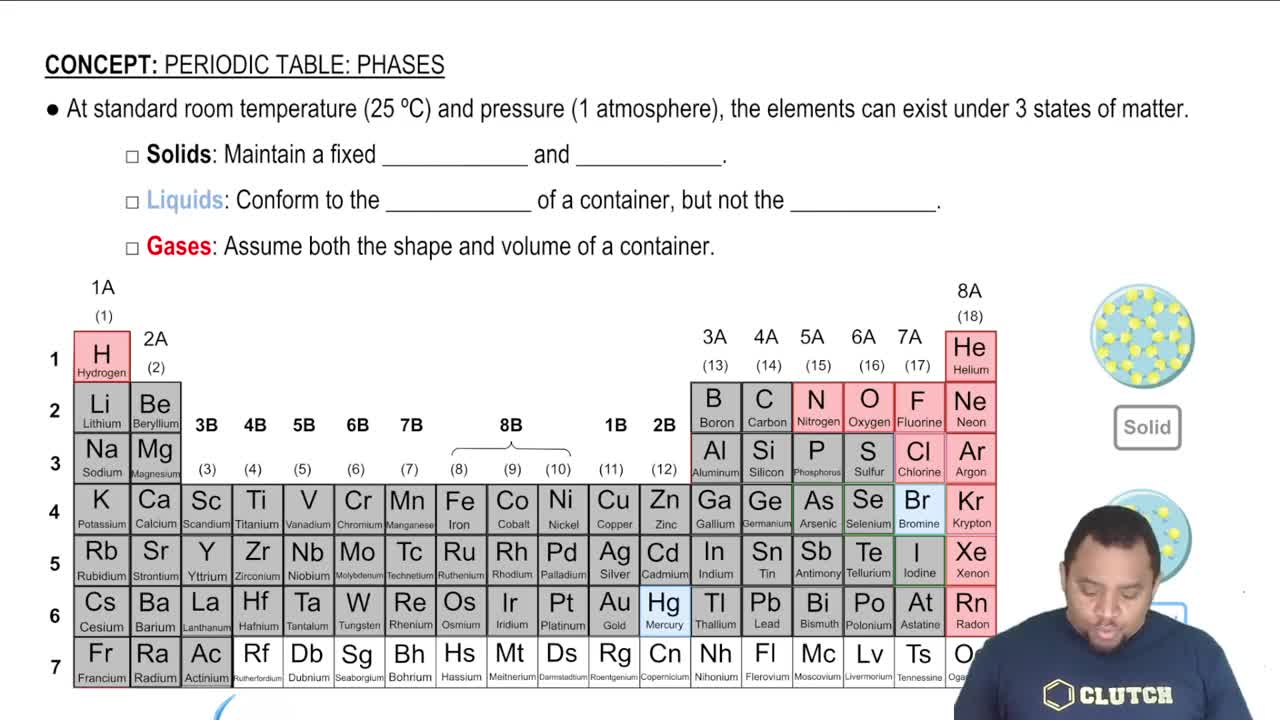
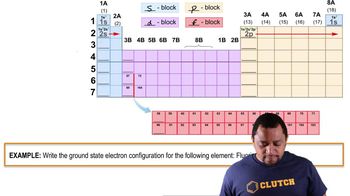
Step 1: Identify the ground state electron configuration of Xenon. Xenon (Xe) is a noble gas and its atomic number is 54. The electron configuration of Xenon in its ground state is [Kr] 5s2 4d10 5p6.
Step 2: Understand the concept of excitation. When an atom absorbs energy, one of its electrons can be excited to a higher energy level. In this case, Xenon is absorbing energy and one of its electrons is being promoted to the next available subshell.
Step 3: Identify the next available subshell. After the 5p subshell (which is filled in the ground state), the next available subshell is 5d.
Step 4: Write the electron configuration for the excited state. When one electron from the 5p subshell is excited to the 5d subshell, the electron configuration becomes [Kr] 5s2 4d10 5p5 5d1.
Step 5: Remember that this is an unstable, excited state. The atom will eventually release the absorbed energy and return to its ground state configuration.
비슷한 문제에 대한 검증된 영상 답변:
이 영상 해법은 위 문제에 도움이 된다고 튜터들이 추천한 것입니다.
영상 길이:
1m
영상 재생:
0 댓글
주요 개념
질문에 올바르게 답하기 위해 반드시 이해해야 하는 핵심 개념들은 다음과 같습니다.
Electron Configuration
Electron configuration describes the distribution of electrons in an atom's orbitals. It is represented using a notation that indicates the energy levels and subshells occupied by electrons. For example, the ground state electron configuration of xenon (Xe) is 1s² 2s² 2p⁶ 3s² 3p⁶ 4s² 3d¹⁰ 4p⁶, which shows that all its electrons are in their lowest energy states.
An excited state occurs when an electron in an atom absorbs energy and moves to a higher energy level or subshell. This state is temporary, and the electron will eventually return to its ground state, releasing energy in the form of light or heat. In the case of xenon, absorbing 801 kJ/mol promotes an outer electron to the next available subshell, altering its electron configuration.
Subshells are divisions of electron shells that contain orbitals of similar energy. They are denoted as s, p, d, and f, with each type having a specific number of orbitals and maximum electron capacity. Understanding the arrangement of these subshells is crucial for predicting how electrons will be distributed in an atom, especially when considering transitions to excited states.


 검증된 단계별 안내
 01:33
01:33