Ch.8 - Covalent Compounds: Bonding Theories and Molecular Structure
McMurry - Chemistry 8th Edition
McMurry8th EditionChemistryISBN: 9781292336145당신이 사용하는 게 아니라요?교과서 변경
8장, 문제 155

Reaction of gaseous fluorine with compound X yields a sin- gle product Y, whose mass percent composition is 61.7% F and 38.3% Cl. (b) Draw an electron-dot structure for Y, and predict the geometry around the central atom.

검증된 단계별 안내
1
Determine the empirical formula of compound Y using the mass percent composition. Assume a 100 g sample, which means you have 61.7 g of fluorine and 38.3 g of chlorine. Convert these masses to moles by using the atomic masses of fluorine (19 g/mol) and chlorine (35.5 g/mol).
Calculate the mole ratio of fluorine to chlorine by dividing the moles of each element by the smallest number of moles obtained in the previous step. This ratio will help you determine the simplest formula of compound Y.
Use the empirical formula to draw the electron-dot (Lewis) structure of compound Y. Remember that both fluorine and chlorine need to complete their octet (have 8 electrons in their valence shell). Arrange the electrons to satisfy the octet rule for each atom.
Predict the molecular geometry of compound Y using the VSEPR (Valence Shell Electron Pair Repulsion) theory. Count the number of bonding pairs and lone pairs around the central atom to determine the molecular shape.
Based on the VSEPR model, describe the geometry around the central atom. Common geometries include linear, bent, trigonal planar, tetrahedral, trigonal bipyramidal, and octahedral.

비슷한 문제에 대한 검증된 영상 답변:

이 영상 해법은 위 문제에 도움이 된다고 튜터들이 추천한 것입니다.
영상 길이:
8m

주요 개념

질문에 올바르게 답하기 위해 반드시 이해해야 하는 핵심 개념들은 다음과 같습니다.

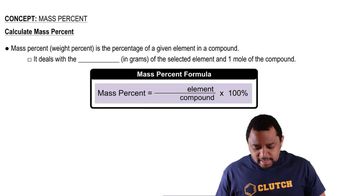
Mass Percent Composition

Mass percent composition refers to the percentage by mass of each element in a compound. It is calculated by dividing the mass of the element in the compound by the total mass of the compound and multiplying by 100. In this case, the mass percent composition of Y indicates that it contains 61.7% fluorine and 38.3% chlorine, which helps in determining the empirical formula of the compound.
추천 영상:
가이드 코스
00:38
Mass Percent Calculation

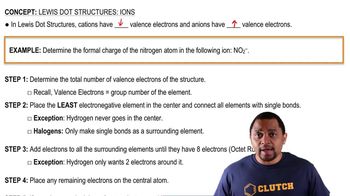
Electron-Dot Structure (Lewis Structure)

An electron-dot structure, or Lewis structure, represents the valence electrons of atoms within a molecule. It shows how the electrons are arranged among the atoms and helps visualize bonding and lone pairs. For compound Y, drawing the electron-dot structure will reveal the connectivity between fluorine and chlorine atoms, aiding in predicting molecular geometry.
추천 영상:
가이드 코스
04:28
Lewis Dot Structures: Ions

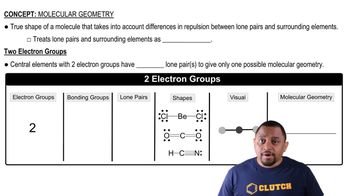
Molecular Geometry

Molecular geometry refers to the three-dimensional arrangement of atoms in a molecule. It is determined by the number of bonding pairs and lone pairs of electrons around the central atom, following the VSEPR (Valence Shell Electron Pair Repulsion) theory. Understanding the geometry of compound Y is crucial for predicting its physical and chemical properties, as well as its reactivity.
추천 영상:
가이드 코스
01:33
Molecular Geometry with Two Electron Groups