Ch.8 - Covalent Compounds: Bonding Theories and Molecular Structure
McMurry - Chemistry 8th Edition
McMurry8th EditionChemistryISBN: 9781292336145당신이 사용하는 게 아니라요?교과서 변경
8장, 문제 153

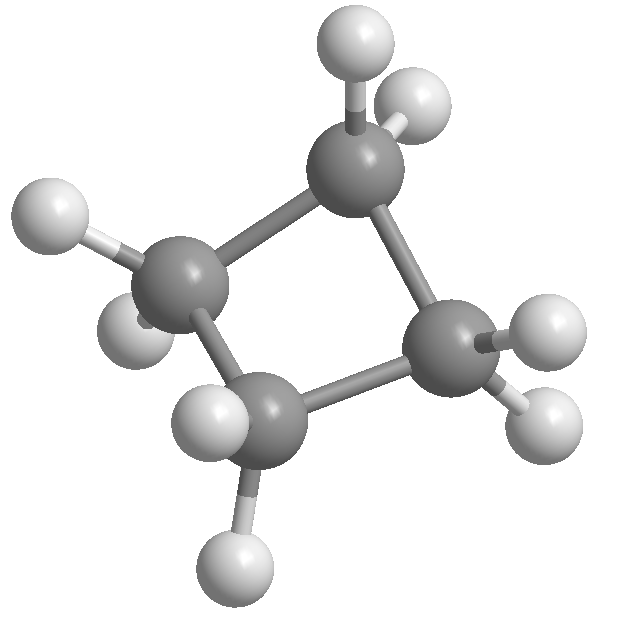
The equilibrium constant Kc for the gas-phase thermal decom-position of cyclopropane to propene is 1.0 * 105 at 500 K: 3D model of cyclopropane showing its molecular structure for hybridization study.
(e) Why is cyclopropane so reactive? (Hint: Consider the hybrid orbitals used by the C atoms.)

검증된 단계별 안내
1
Identify the structure of cyclopropane from the image provided. Cyclopropane is a three-membered ring with each carbon atom bonded to two hydrogen atoms.
Understand that the carbon atoms in cyclopropane are sp3 hybridized, which typically forms tetrahedral angles of 109.5 degrees.
Recognize that in cyclopropane, the bond angles are forced to be 60 degrees due to the three-membered ring structure, which is significantly less than the ideal tetrahedral angle.
Explain that this deviation from the ideal bond angle creates significant angle strain in the molecule, making the bonds weaker and the molecule more reactive.
Conclude that the high reactivity of cyclopropane is due to the angle strain caused by the forced 60-degree bond angles in the sp3 hybridized carbon atoms.

비슷한 문제에 대한 검증된 영상 답변:

이 영상 해법은 위 문제에 도움이 된다고 튜터들이 추천한 것입니다.
영상 길이:
2m

주요 개념

질문에 올바르게 답하기 위해 반드시 이해해야 하는 핵심 개념들은 다음과 같습니다.

Hybridization

Hybridization is the concept of mixing atomic orbitals to form new hybrid orbitals that can accommodate bonding. In cyclopropane, the carbon atoms undergo sp3 hybridization, resulting in four equivalent hybrid orbitals that form sigma bonds with adjacent atoms. This arrangement leads to a tetrahedral geometry, which is strained in a three-membered ring, contributing to the molecule's reactivity.
추천 영상:

Ring Strain

Ring strain occurs in cyclic compounds when the bond angles deviate from the ideal tetrahedral angle of 109.5 degrees. In cyclopropane, the three-membered ring forces the bond angles to approximately 60 degrees, creating significant angle strain. This strain makes cyclopropane more reactive than larger cyclic hydrocarbons, as the molecule seeks to relieve this strain through chemical reactions.
추천 영상:
가이드 코스
01:21
Chelating Agents

Reactivity of Alkenes

The reactivity of alkenes is largely due to the presence of a carbon-carbon double bond, which is more reactive than single bonds. In the thermal decomposition of cyclopropane to propene, the formation of propene involves breaking the strained cyclopropane structure and forming a more stable alkene. The transition from a strained cyclic structure to a more stable linear alkene contributes to the overall reactivity of cyclopropane.
추천 영상:
가이드 코스
02:47
Rules for Naming Alkenes