Ch.9 - Thermochemistry: Chemical Energy
McMurry - Chemistry 8th Edition
McMurry8th EditionChemistryISBN: 9781292336145당신이 사용하는 게 아니라요?교과서 변경
9장, 문제 37

A reaction is carried out in a cylinder fitted with a movable piston. The starting volume is V = 5.00 L, and the appa- ratus is held at constant temperature and pressure. Assum- ing that ∆H = -35.0 kJ and ∆E = -34.8 kJ, redraw the piston to show its position after reaction. Does V increase, decrease, or remain the same? Illustration of a cylinder with a piston at constant pressure of 1.7 atm for thermochemistry.

검증된 단계별 안내
1
Step 1: Identify the given values: initial volume (V) = 5.00 L, ΔH = -35.0 kJ, and ΔE = -34.8 kJ.
Step 2: Recall the relationship between enthalpy change (ΔH), internal energy change (ΔE), and work (w) done by the system: ΔH = ΔE + PΔV.
Step 3: Since the process occurs at constant pressure (P = 1.7 atm), use the equation ΔH = ΔE + PΔV to solve for ΔV (change in volume). Rearrange the equation to find ΔV: ΔV = (ΔH - ΔE) / P.
Step 4: Substitute the given values into the equation: ΔV = (-35.0 kJ - (-34.8 kJ)) / 1.7 atm. Note that 1 kJ = 1000 J, so convert kJ to J if necessary.
Step 5: Determine whether ΔV is positive, negative, or zero. If ΔV is positive, the volume increases; if ΔV is negative, the volume decreases; if ΔV is zero, the volume remains the same. Redraw the piston accordingly.

비슷한 문제에 대한 검증된 영상 답변:

이 영상 해법은 위 문제에 도움이 된다고 튜터들이 추천한 것입니다.
영상 길이:
6m

주요 개념

질문에 올바르게 답하기 위해 반드시 이해해야 하는 핵심 개념들은 다음과 같습니다.

Enthalpy (∆H)

Enthalpy is a thermodynamic quantity that represents the total heat content of a system. It is defined as the internal energy of the system plus the product of its pressure and volume (H = E + PV). In this reaction, a negative change in enthalpy (∆H = -35.0 kJ) indicates that the reaction releases heat to the surroundings, suggesting an exothermic process.
추천 영상:
가이드 코스
02:34
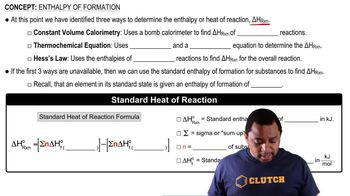
Enthalpy of Formation

Internal Energy (∆E)

Internal energy is the total energy contained within a system, including kinetic and potential energies of the particles. The change in internal energy (∆E) reflects the energy exchanged with the surroundings. In this case, ∆E = -34.8 kJ, which is also negative, indicating that energy is released during the reaction, but the difference between ∆H and ∆E suggests work is done on the system.
추천 영상:
가이드 코스
00:40
Internal Energy

Work and Volume Change

In a system with a movable piston, the work done by or on the system is related to changes in volume. At constant pressure, the work (W) can be calculated as W = -P∆V, where ∆V is the change in volume. Given that the reaction releases energy and the enthalpy change is negative, it implies that the volume of the gas must decrease, causing the piston to move downwards.
추천 영상:
가이드 코스
02:35
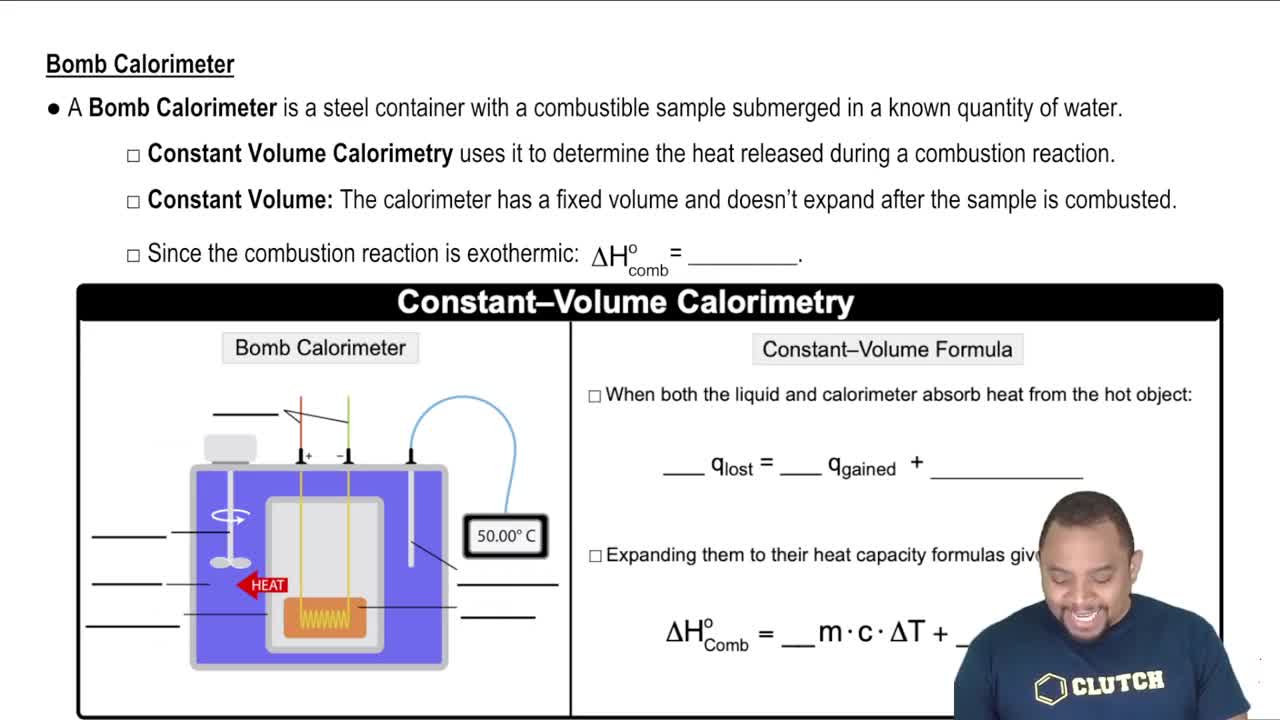
Constant-Volume Calorimetry