Ch.9 - Thermochemistry: Chemical Energy
McMurry - Chemistry 8th Edition
McMurry8th EditionChemistryISBN: 9781292336145당신이 사용하는 게 아니라요?교과서 변경
9장, 문제 36b

Redraw the following diagram to represent the situation (b) when work has been lost by the system.
Diagram showing a cylinder with pressure P acting downwards on a liquid surface.

검증된 단계별 안내
1
Step 1: Identify the initial state of the system. The diagram shows a cylinder with a piston applying pressure (P) downwards on a liquid surface.
Step 2: Understand the concept of work done by the system. When work is done by the system, it typically involves the system expanding against an external pressure.
Step 3: Consider the scenario where work has been lost by the system. This implies that the system has done work on the surroundings, causing the piston to move upwards.
Step 4: Redraw the diagram to reflect the new situation. The piston should be at a higher position than initially, indicating that the system has expanded.
Step 5: Ensure the pressure (P) is still acting downwards on the piston, but the volume of the liquid has increased, showing that work has been done by the system.

비슷한 문제에 대한 검증된 영상 답변:

이 영상 해법은 위 문제에 도움이 된다고 튜터들이 추천한 것입니다.
영상 길이:
3m

주요 개념

질문에 올바르게 답하기 위해 반드시 이해해야 하는 핵심 개념들은 다음과 같습니다.

Work in Thermodynamics

In thermodynamics, work is defined as the energy transfer that occurs when a force is applied over a distance. When a system does work on its surroundings, it loses energy, which can affect its internal energy and temperature. Understanding how work is done by or on a system is crucial for analyzing energy changes in processes such as expansion or compression.
추천 영상:
가이드 코스
01:18
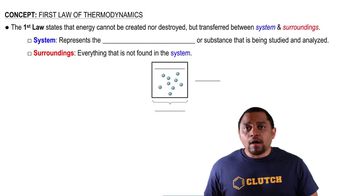
First Law of Thermodynamics

Pressure and Force

Pressure is defined as the force exerted per unit area on a surface. In the context of the diagram, the pressure (P) acting downwards on the liquid surface indicates the force applied by the gas or liquid above it. This concept is essential for understanding how pressure influences the behavior of fluids and the work done by the system.
추천 영상:
가이드 코스
01:52
Relationship between Intermolecular Forces and Vapor Pressure Example

System and Surroundings

In thermodynamics, a system refers to the part of the universe being studied, while the surroundings are everything outside the system. When analyzing work done by a system, it is important to distinguish between energy changes within the system and those in the surroundings. This distinction helps in understanding how energy is transferred and conserved during processes.
추천 영상:
가이드 코스
00:53
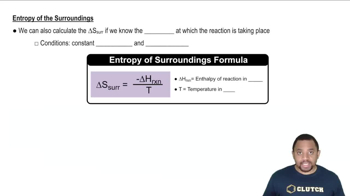
Entropy of Surroundings Formula