
Ch.13 - Solutions
Tro - Chemistry: A Molecular Approach 4th Edition
Tro4th EditionChemistry: A Molecular ApproachISBN: 9780134112831당신이 사용하는 게 아니라요?교과서 변경
13장, 문제 9

What is the required concentration (in percent by mass) for an aqueous ethylene glycol (C2H6O2) solution to have a boiling point of 104.0 °C?

검증된 단계별 안내
1
insert step 1: Understand that the boiling point elevation formula is \( \Delta T_b = i \cdot K_b \cdot m \), where \( \Delta T_b \) is the boiling point elevation, \( i \) is the van't Hoff factor, \( K_b \) is the ebullioscopic constant of the solvent, and \( m \) is the molality of the solution.
insert step 2: Calculate \( \Delta T_b \) by subtracting the normal boiling point of water (100.0 °C) from the given boiling point (104.0 °C).
insert step 3: Use the van't Hoff factor \( i = 1 \) for ethylene glycol, as it does not dissociate in solution.
insert step 4: Rearrange the boiling point elevation formula to solve for molality \( m \): \( m = \frac{\Delta T_b}{i \cdot K_b} \). Use the known \( K_b \) value for water, which is 0.512 °C kg/mol.
insert step 5: Convert the molality to percent by mass. Assume a certain mass of water (e.g., 1 kg) to find the mass of ethylene glycol using its molality, then calculate the percent by mass using the formula: \( \text{percent by mass} = \frac{\text{mass of solute}}{\text{mass of solution}} \times 100\%.\)

주요 개념

질문에 올바르게 답하기 위해 반드시 이해해야 하는 핵심 개념들은 다음과 같습니다.

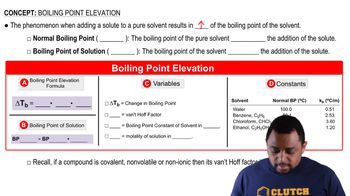
Boiling Point Elevation

Boiling point elevation is a colligative property that describes how the boiling point of a solvent increases when a solute is added. This phenomenon occurs because the presence of solute particles disrupts the formation of vapor above the liquid, requiring a higher temperature to reach the boiling point. The relationship is quantified by the formula ΔT_b = i * K_b * m, where ΔT_b is the boiling point elevation, i is the van 't Hoff factor, K_b is the ebullioscopic constant, and m is the molality of the solution.
추천 영상:
가이드 코스
03:05
Boiling Point Elevation

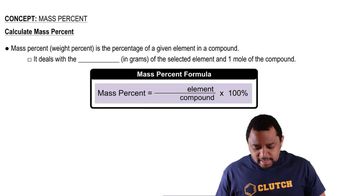
Percent by Mass Concentration

Percent by mass concentration is a way to express the concentration of a solution, defined as the mass of solute divided by the total mass of the solution, multiplied by 100. This measurement is useful for understanding how much solute is present in a given mass of solution, which is essential for calculations involving colligative properties like boiling point elevation. For example, a 10% by mass solution of ethylene glycol means that there are 10 grams of ethylene glycol in every 100 grams of solution.
추천 영상:
가이드 코스
00:38
Mass Percent Calculation

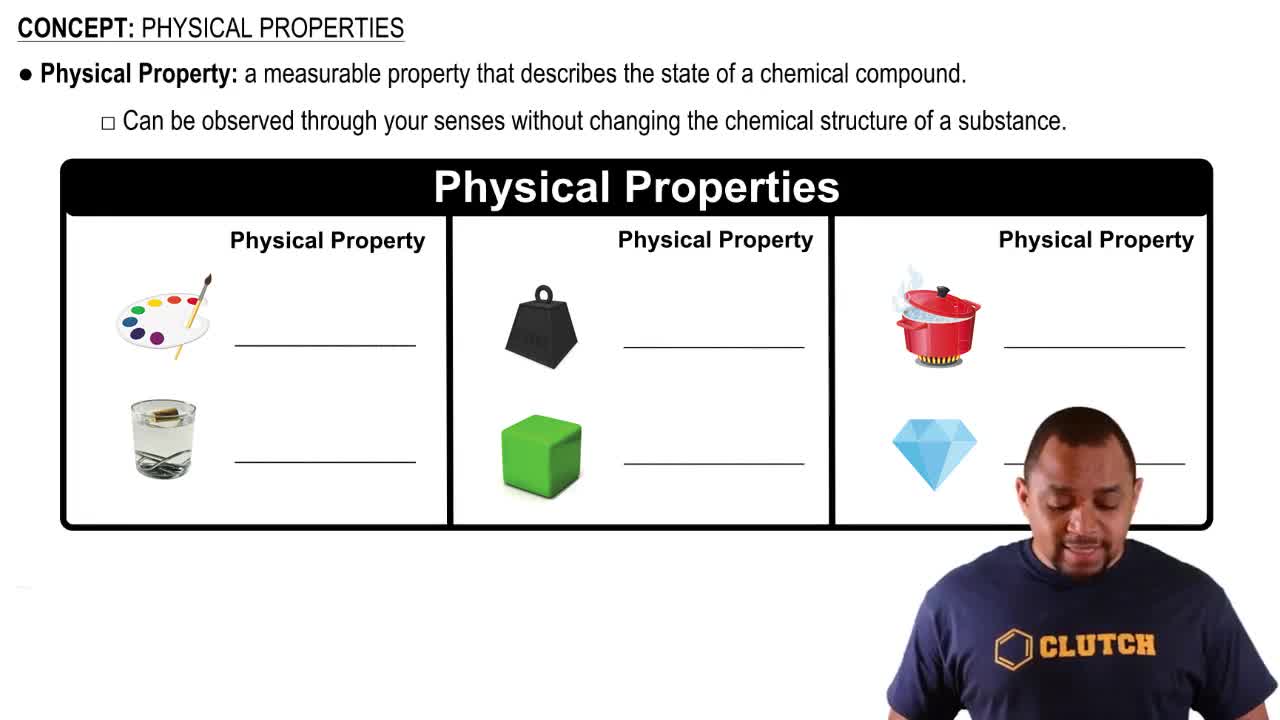
Ethylene Glycol Properties

Ethylene glycol (C2H6O2) is a colorless, odorless liquid commonly used as an antifreeze and coolant. It has a relatively high boiling point compared to water, which allows it to be effective in raising the boiling point of aqueous solutions. Understanding the physical properties of ethylene glycol, including its boiling point and how it interacts with water, is crucial for calculating the required concentration to achieve a specific boiling point in a solution.
추천 영상:
가이드 코스
02:54
Physical Properties