
Ch.13 - Solutions
Tro - Chemistry: A Molecular Approach 4th Edition
Tro4th EditionChemistry: A Molecular ApproachISBN: 9780134112831당신이 사용하는 게 아니라요?교과서 변경
13장, 문제 73d

A solution contains 50.0 g of heptane (C7H16) and 50.0 g of octane (C8H18) at 25 °C. The vapor pressures of pure heptane and pure octane at 25 °C are 45.8 torr and 10.9 torr, respectively. Assuming ideal behavior, answer the following: d. Why is the composition of the vapor different from the composition of the solution?

검증된 단계별 안내
1
Understand the concept of Raoult's Law, which states that the partial vapor pressure of each component in an ideal solution is proportional to the mole fraction of the component in the solution and its vapor pressure when pure.
Calculate the mole fractions of heptane and octane in the solution. First, find the molar mass of heptane (C7H16) and octane (C8H18), then use these to convert the masses of heptane and octane in the solution to moles.
Using the moles calculated, determine the mole fraction of each component (heptane and octane) in the solution by dividing the moles of each component by the total moles of the solution.
Apply Raoult's Law to find the partial vapor pressures of heptane and octane in the solution. Multiply the mole fraction of each component by its respective pure component vapor pressure.
Explain that the composition of the vapor is different from the composition of the solution because the component with the higher vapor pressure (in this case, heptane) will have a greater contribution to the total vapor pressure, thus it will be more prevalent in the vapor phase compared to its proportion in the liquid phase.

비슷한 문제에 대한 검증된 영상 답변:

이 영상 해법은 위 문제에 도움이 된다고 튜터들이 추천한 것입니다.
영상 길이:
2m

주요 개념

질문에 올바르게 답하기 위해 반드시 이해해야 하는 핵심 개념들은 다음과 같습니다.

Raoult's Law

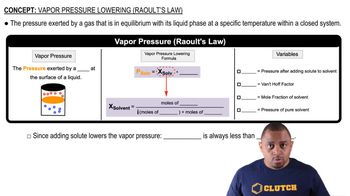
Raoult's Law states that the vapor pressure of a solvent in a solution is directly proportional to the mole fraction of the solvent in the solution. This principle helps explain how the presence of different components in a solution affects the overall vapor pressure, leading to variations in the composition of the vapor compared to the liquid phase.
추천 영상:
가이드 코스
02:40
Raoult's Law and Vapor Pressure

Vapor-Liquid Equilibrium

Vapor-liquid equilibrium refers to the state where the rate of evaporation of a liquid equals the rate of condensation of its vapor. In a mixture of volatile liquids like heptane and octane, the equilibrium composition of the vapor will differ from that of the liquid due to differences in their individual vapor pressures and mole fractions.
추천 영상:
가이드 코스
02:40
Raoult's Law and Vapor Pressure

Ideal Solutions

An ideal solution is one where the interactions between different molecules are similar to those between like molecules, leading to predictable behavior according to Raoult's Law. In the case of heptane and octane, assuming ideal behavior allows us to use their vapor pressures to determine how their mixture will behave, including the differences in vapor composition.
추천 영상:
가이드 코스
01:39
Solution Components