
A solution contains a mixture of pentane and hexane at room temperature. The solution has a vapor pressure of 258 torr. Pure pentane and hexane have vapor pressures of 425 torr and 151 torr, respectively, at room temperature. What is the mole fraction composition of the mixture? (Assume ideal behavior.)
Ch.13 - Solutions
13장, 문제 71
Calculate the vapor pressure of a solution containing 24.5 g of glycerin (C3H8O3) in 135 mL of water at 30.0 °C. The vapor pressure of pure water at this temperature is 31.8 torr. Assume that glycerin is not volatile and dissolves molecularly (i.e., it is not ionic), and use a density of 1.00 g/mL for the water.
검증된 단계별 안내1
Calculate the number of moles of glycerin (C3H8O3) using its molar mass. The molar mass of glycerin is calculated by adding the atomic masses of its constituent atoms: 3 carbons (C), 8 hydrogens (H), and 3 oxygens (O).
Determine the mass of water in grams using the given density and volume. Since the density of water is given as 1.00 g/mL, multiply the volume of water (135 mL) by the density to find the mass in grams.
Calculate the number of moles of water using its molar mass. The molar mass of water (H2O) is the sum of the atomic masses of 2 hydrogens and 1 oxygen.
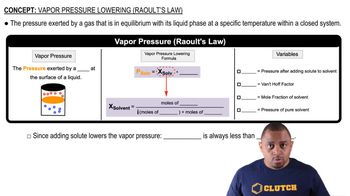
Use Raoult's Law to find the vapor pressure of the solution. Raoult's Law states that the vapor pressure of a solution is equal to the mole fraction of the solvent times the vapor pressure of the pure solvent. Calculate the mole fraction of water by dividing the moles of water by the total moles of the solution (moles of water + moles of glycerin).
Multiply the mole fraction of water by the vapor pressure of pure water at 30.0 °C to find the vapor pressure of the solution.

비슷한 문제에 대한 검증된 영상 답변:
이 영상 해법은 위 문제에 도움이 된다고 튜터들이 추천한 것입니다.
영상 길이:
4m주요 개념
질문에 올바르게 답하기 위해 반드시 이해해야 하는 핵심 개념들은 다음과 같습니다.
Vapor Pressure
Vapor pressure is the pressure exerted by a vapor in equilibrium with its liquid or solid form at a given temperature. It reflects the tendency of particles to escape from the liquid phase into the vapor phase. In solutions, the presence of a non-volatile solute, like glycerin, lowers the vapor pressure of the solvent compared to its pure state.
추천 영상:
가이드 코스
Raoult's Law and Vapor Pressure
Raoult's Law
Raoult's Law states that the vapor pressure of a solvent in a solution is directly proportional to the mole fraction of the solvent. This law is crucial for calculating the vapor pressure of a solution when a non-volatile solute is present. It helps determine how the addition of solute affects the overall vapor pressure of the solvent.
추천 영상:
가이드 코스
Raoult's Law and Vapor Pressure
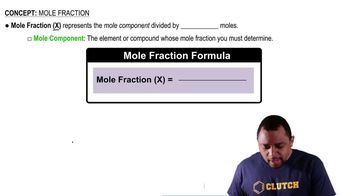
Mole Fraction
Mole fraction is a way of expressing the concentration of a component in a mixture, defined as the number of moles of that component divided by the total number of moles of all components. In this context, calculating the mole fraction of water in the solution is essential for applying Raoult's Law to find the new vapor pressure after glycerin is added.
추천 영상:
가이드 코스
Mole Fraction Formula
관련 실천
교과서 질문
3035
views
1
comments
교과서 질문
A solution contains 50.0 g of heptane (C7H16) and 50.0 g of octane (C8H18) at 25 °C. The vapor pressures of pure heptane and pure octane at 25 °C are 45.8 torr and 10.9 torr, respectively. Assuming ideal behavior, answer the following: d. Why is the composition of the vapor different from the composition of the solution?
1207
views
교과서 질문
Which solution has the highest vapor pressure? a. 20.0 g of glucose (C6H12O6) in 100.0 mL of water b. 20.0 g of sucrose (C12H22O11) in 100.0 mL of water c. 10.0 g of potassium acetate KC2H3O2 in 100.0 mL of water
2052
views
1
comments
