

Ch.13 - Solutions
Tro - Chemistry: A Molecular Approach 4th Edition
Tro4th EditionChemistry: A Molecular ApproachISBN: 9780134112831당신이 사용하는 게 아니라요?교과서 변경
13장, 문제 70

Which solution has the highest vapor pressure? a. 20.0 g of glucose (C6H12O6) in 100.0 mL of water b. 20.0 g of sucrose (C12H22O11) in 100.0 mL of water c. 10.0 g of potassium acetate KC2H3O2 in 100.0 mL of water

검증된 단계별 안내
1
Identify the molecular weights of glucose (C6H12O6), sucrose (C12H22O11), and potassium acetate (KC2H3O2).
Calculate the number of moles of each solute using the formula: number of moles = mass of solute (g) / molecular weight of solute (g/mol).
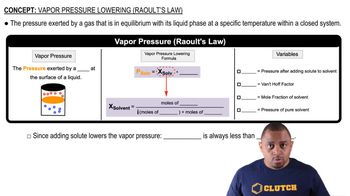
Understand that according to Raoult's Law, the vapor pressure of a solution is directly proportional to the mole fraction of the solvent. Therefore, the more solute particles present, the lower the vapor pressure of the solution.
Compare the number of moles calculated for each solution to determine which has the fewest moles of solute. This solution will have the highest mole fraction of water and thus the highest vapor pressure.
Conclude that the solution with the highest vapor pressure is the one with the fewest moles of solute, as it will have the least impact on lowering the vapor pressure of the water.

비슷한 문제에 대한 검증된 영상 답변:

이 영상 해법은 위 문제에 도움이 된다고 튜터들이 추천한 것입니다.
영상 길이:
5m
도움이 되었나요?

주요 개념

질문에 올바르게 답하기 위해 반드시 이해해야 하는 핵심 개념들은 다음과 같습니다.

Vapor Pressure

Vapor pressure is the pressure exerted by a vapor in equilibrium with its liquid or solid phase at a given temperature. It reflects the tendency of particles to escape from the liquid phase into the vapor phase. Solutions with lower concentrations of solute typically have higher vapor pressures because fewer solute particles disrupt the escape of solvent molecules.
추천 영상:
가이드 코스
02:40
Raoult's Law and Vapor Pressure

Colligative Properties

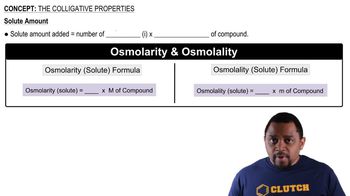
Colligative properties are properties of solutions that depend on the number of solute particles in a given amount of solvent, rather than the identity of the solute. These properties include vapor pressure lowering, boiling point elevation, freezing point depression, and osmotic pressure. The more solute particles present, the greater the effect on the vapor pressure, leading to a lower vapor pressure for more concentrated solutions.
추천 영상:
가이드 코스
01:26
Colligative Properties

Molar Mass and Particle Count

The molar mass of a solute determines how many moles are present in a given mass of solute. For example, glucose (C6H12O6) has a lower molar mass than sucrose (C12H22O11), meaning that for the same mass, glucose will produce more moles of solute particles in solution. This difference in particle count affects the colligative properties, including vapor pressure, as more particles lead to a greater lowering of vapor pressure.
추천 영상:
가이드 코스
02:11
Molar Mass Concept